
Based on the book, “The Rabbit King” by Catherine Watson
and compiled by Ilma Hackett (Balnarring & District Historical Society)
In the early years of the 20th century, Michael McCraith, a printer, and his wife, Mary, rented a Victorian cottage in Kensington opposite the Newmarket Saleyards. The couple’s first-born, George, died in infancy. Then came a son, Gerald Mack, in 1909, a daughter, May, two years later and John Andrew, the last child, in 1916. John was called Jack from an early age.
Their lives changed when, in 1922, the family moved into their own, brand-new house in Essendon on the outskirts of Melbourne. Michael had paid £10 for a block of land in Cooper Street and borrowed £800 to build a three-bedroom, weatherboard house. The children now had open paddocks as their playground and Michael, a keen shooter, found quail and hares in the rural land on his doorstep.
Complete opposites
Jack, like his father, loved hunting and shooting while Gerald was the complete opposite. Although he enjoyed sport, Gerald was bookish. He wore glasses and was considered a ‘brain box’. While Jack was out in the country with his ferrets or setting his rabbit traps, Gerald was studying nature. He left school at 14, despite winning a scholarship to Trinity Grammar, as the family could not afford the cost of books and uniform.
From his early teens he joined like-minded friends and scoured the area around Melbourne in what would become a life-long search for rare orchids. He took every opportunity to collect orchid specimens. “You destroy things, I create them”, he once told his brother, a remark that long rankled. The differences between the two brothers widened as they grew older. However, they shared one important characteristic– a burning desire to make their own way. “We all learned to buy and sell at an early age because times were pretty tight,” Gerald recalled. “This was the 1930s and things were pretty tough all round. If you didn’t get off your backside and do something for yourself, you starved . . . You’d keep your eye open for any job or anything you could do to earn a bob or two.”
Jack’s Decision
When Jack was fifteen he made a pivotal decision. “Everyone knows how to catch rabbits,” he said, “I’ll learn how to sell them.” On his first buying trip he rode his bike into the nearby countryside towards Bulla and bought two rabbits. At home he skinned them in the back yard, then sold them at a profit to the neighbours. This he continued to do, buying in increasing numbers and making himself known to, and respected by, the shooters. When he was seventeen Jack worked at Noon Pies, earning 7/6 a week. Selling rabbits earned him more and as soon as he was sure that they would supply a regular income, Jack left Noon Pies and struck out on his own.
Gerald worked at various jobs after leaving school and established a mail-order orchid business, selling orchids he propagated at home. He married in 1930 and he and his wife, Ellen (Nell) bought a milk bar. Gerald sold milk door-to-door while Nell worked in the shop. Two years later they established Mack’s Lending Library from a shop in Essendon. Gerald made rounds with a handcart of books then, as the business grew, the handcart was replaced by a motor cycle and sidecar.
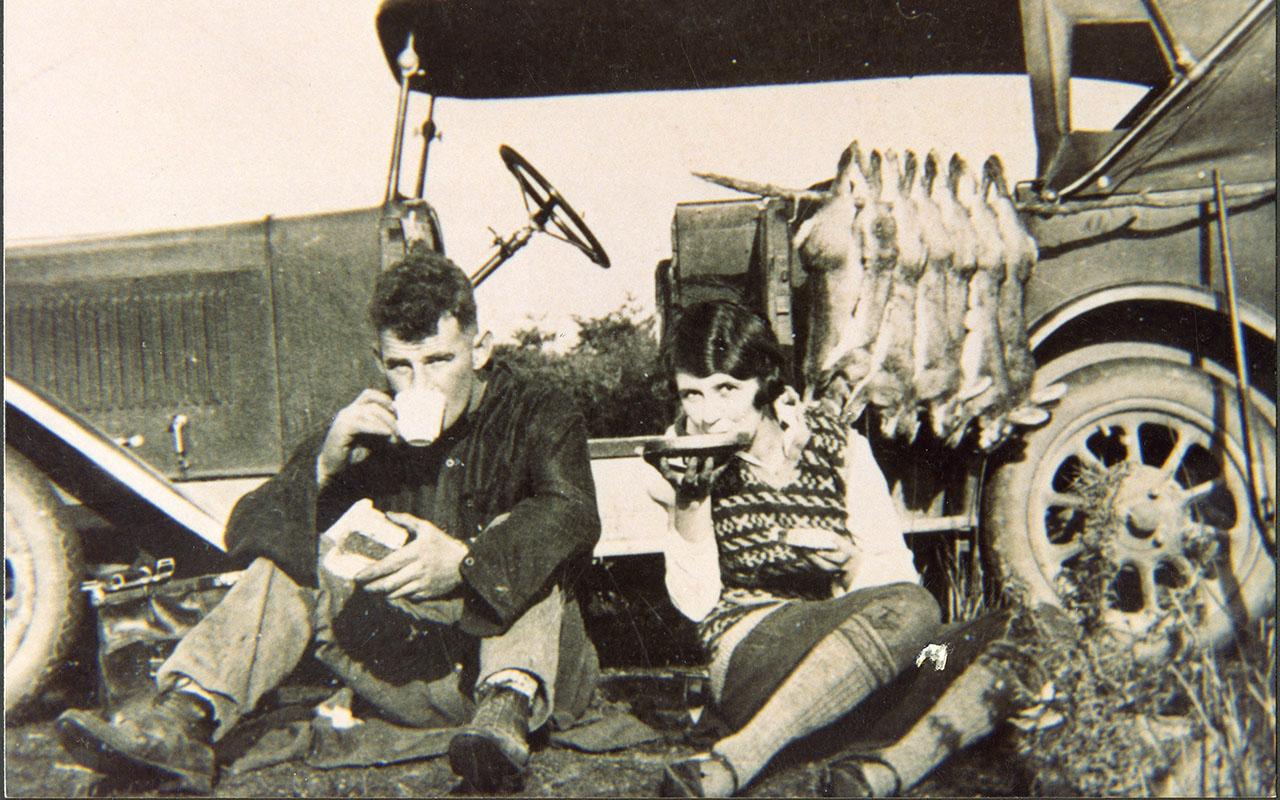
Jack’s rabbit business continued to expand, with Gerald helping Jack to skin and gut the rabbits. Jack pursued rabbits further afield, visiting Kilmore, Romsey and Lancefield one day, the Mornington Peninsula the next. He had a lot of trappers working on Cape Schanck, an area covered with ti-tree and a haven for rabbits. With a trailer on the back of his Harley Davidson motorbike and a box as a sidecar, he could carry about 600 pairs of rabbits. He brought them back to the Brunswick ice-works where they now processed the rabbits, then he and Gerald worked late into the night skinning and cleaning them. When they finished early the next morning, Jack loaded up his motorbike and went out selling, while Gerald cleaned up and left to do his library round.
By 1940 Jack had 184 depots throughout Victoria, N.S.W. and S.A. where trappers and shooters could bring their catch. It was a competitive business and hunters were, in general, a rough lot but so was Jack. He conducted business in person and they knew they could trust him. Moreover, Jack McCraith paid cash, on the spot.
World War 2 boosts business
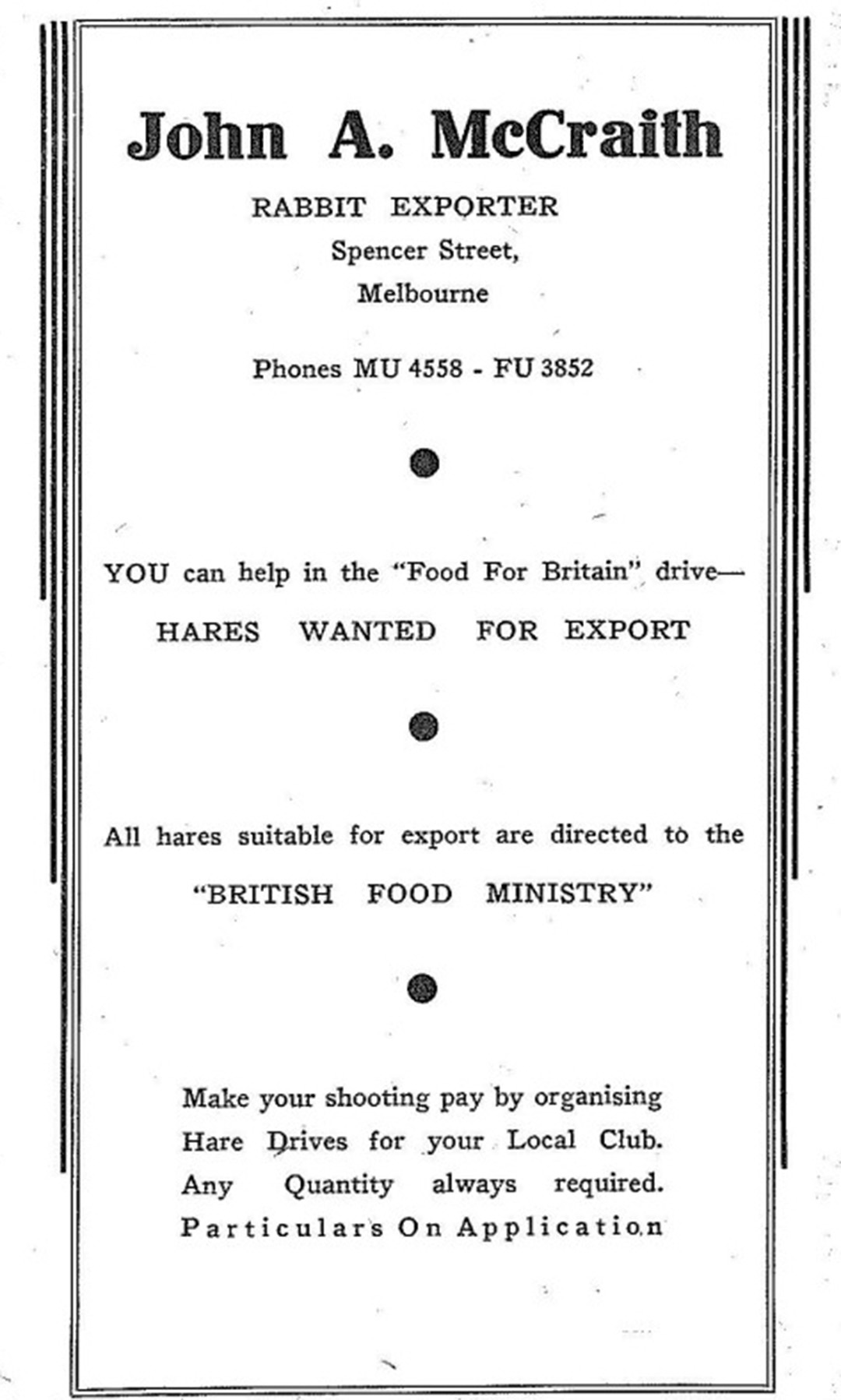
When the Second World War broke out in 1939, Gerald was one of the first to join up. He had joined the Citizens Military Forces early in the 1930s and when war was declared, went straight into the army. Later he transferred to the Royal Air Force as an instructor in signals. He was in Darwin when it was bombed by the Japanese in 1942-3. Gerald demobbed before the end of the war and joined Jack in his rabbiting business to help feed troops in army camps around Victoria. The two brothers formed a partnership. Jack’s job was to get rabbits into the factory as cheaply as possible, and Gerald’s job was to sell them for as much as possible.
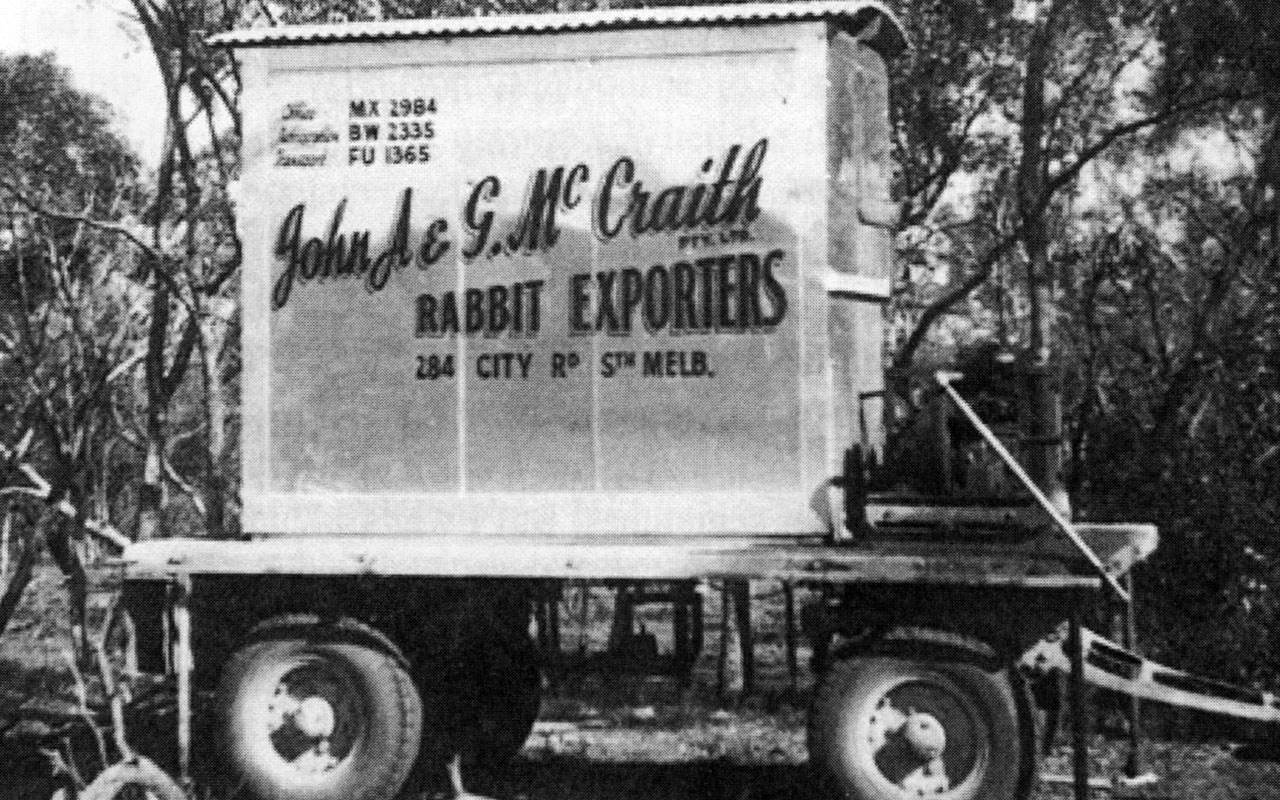
They pioneered the use of refrigerated transport to bring carcases from as far away as the Western Australian border. Rabbits were now processed at the Melbourne Fish Market on the banks of the Yarra River. (When it was demolished in 1957, they moved to City Rd, South Melbourne.) Gerald explored overseas markets for the post-war years. By the late 1940s the company was one of the largest exporters of rabbits in Victoria. An article in PIX magazine on 27 September, 1947 detailed how the McCraith business operated. It reported that “in the year before the war Australia exported skins worth just under £1,000,000 and carcases worth just under £500,000. Last year receipts were £6,000,000 for skins and £1,00,000 for carcasses.” J. A. & G. McCraith, which traded until the early 1980s, was the last company in Victoria to hold a rabbit export licence. The company contributed to the control of feral rabbits in outback Australia and exported more than 32,000 rabbits a week to Sainsbury’s, the big British food company; sold hares to Belgium and the Netherlands; rabbits’ feet to Japan to be made into lucky charms; rabbit skins to the Akubra Hat Company and rabbit fur for the fashion industry. Over 130 million rabbits were exported during the company’s period of operation.
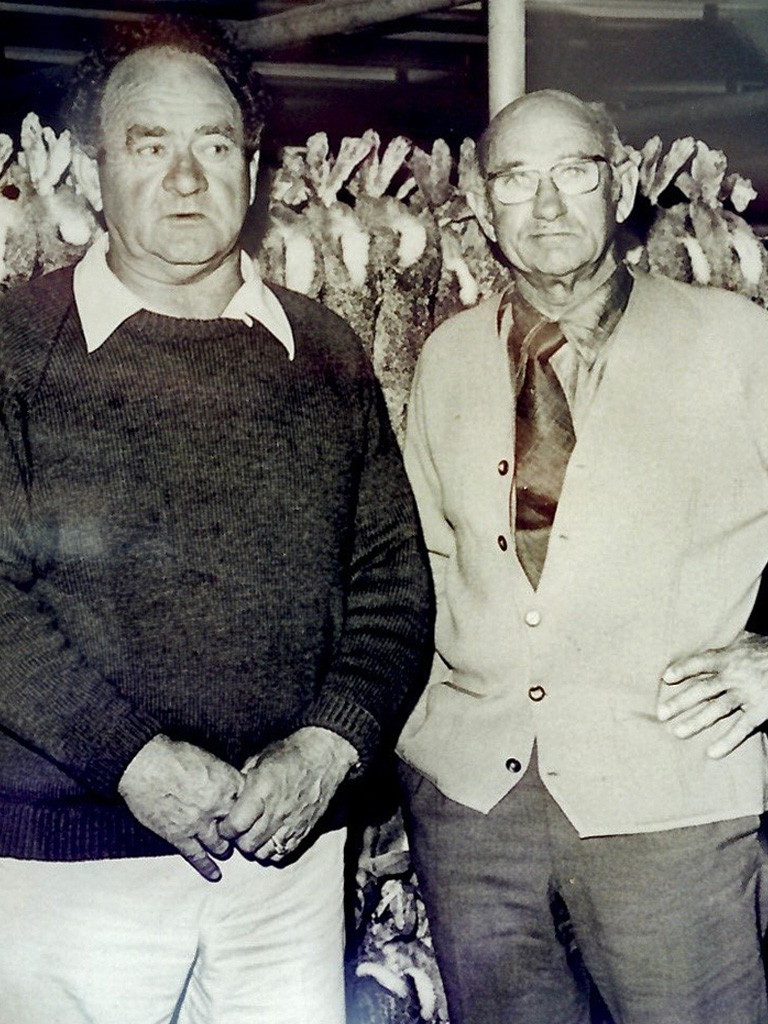
What is surprising, given their diverse interests, is that the brothers made a superb team. They trusted each other’s judgement and integrity and worked together for more than 40 years. By the 1950s they were millionaires. Jack’s reputation as the Rabbit King was firmly established and rail or road trucks with their logo were widely recognised.
The company continued to prosper throughout the 1950s despite the introduction of myxomatosis. It obtained rabbits from the drier, inland areas unaffected by mosquitoes. However, the introduction of battery-raised chickens brought a decline in demand when chicken replaced rabbit as a cheap form of meat. Then, in the 1960s, China entered the export market. Its communist government made it compulsory for every village household to raise rabbits for export. Chinese rabbits were smaller and of inferior quality but they were so much cheaper. In the 1970s Whitlam’s Labour Government made sweeping changes to the food industry. It raised workers’ wages and introduced tighter regulations and inspections. Bureaucratic red tape became a nightmare. The brothers decided to quit. They sold their business in 1980 for $1,000,000.
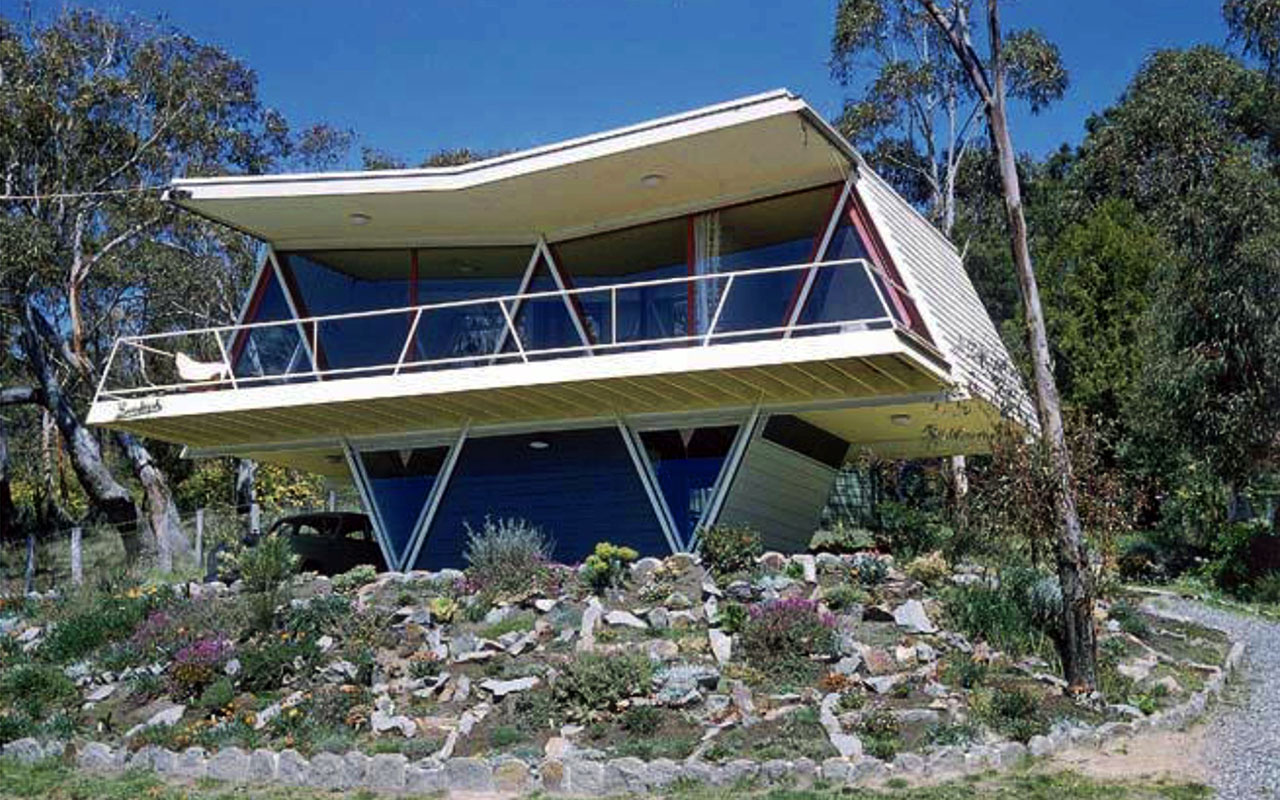
‘Larrakeya’, Gerald’s dream home
Dromana, on the Mornington Peninsula, was relatively undeveloped in the 1950s. Gerald and Nell owned several bush blocks in Atunga Terrace. In 1954 they commissioned architect, David Chancellor, of Chancellor and Patrick, to design what became one of the most remarkable buildings on the peninsula. The house, at 1 Atunga Terrace, was known as the Butterfly House due to its unique geometric shape. Max Howell, a Dromana builder supervised its building. Construction began at Easter, 1956. Gerald named the house ‘Larrakeyah’ after the army camp where he was stationed in Darwin. The Shire of Flinders Heritage Study (1992) declared it to be “of state significance as an innovative design which explores architectural concerns of its era in a creative and influential manner.” It featured in an exhibition at the Mornington Peninsula Regional Gallery in 2006, and again in 2009. Today it has national heritage listing. Amazingly, it remains exactly as it was in 1956 – down to the interior and exterior wall colour, furniture, crockery, even the bed linen. In 2013, the house was gifted to RMIT University, and now serves as accommodation for RMIT’s writer-in-residence program.
In Pursuit of Orchids
Gerald’s interest in orchids became a lifetime passion. In 1931 he joined the Victorian Orchid Club, becoming its president from 1959 until 1962. In 1960 he was instrumental in founding the Australian Orchid Council and four years later was its president.
In 1976, Gerald co-founded the Australian Orchid Foundation, a not-for-profit organisation that raises and distributes funds to promote scientific research on Australasian orchids and in 1986, after twenty years of campaigning, he was successful in realising his vision to have Australian native orchids featured on a set of Australia Post stamps. His passion for propagating orchids and for furthering the appreciation of Australian indigenous orchids led to an Order of Australia award for services to horticulture. Two of his hybrids bear his name. Gerald travelled widely to remote areas in his quest to locate rare orchids and he attended every World Orchid Conference from the fourth conference, held in Singapore in 1963, until the seventeenth in Malaysia in 2002 when he was 93 years old. In 2002 he flew to the U.S.A. to receive an award for his philanthropic activities.
Gerald McCraith died on 26 May, 2009, aged 100.
A Hall of Fame Shooter
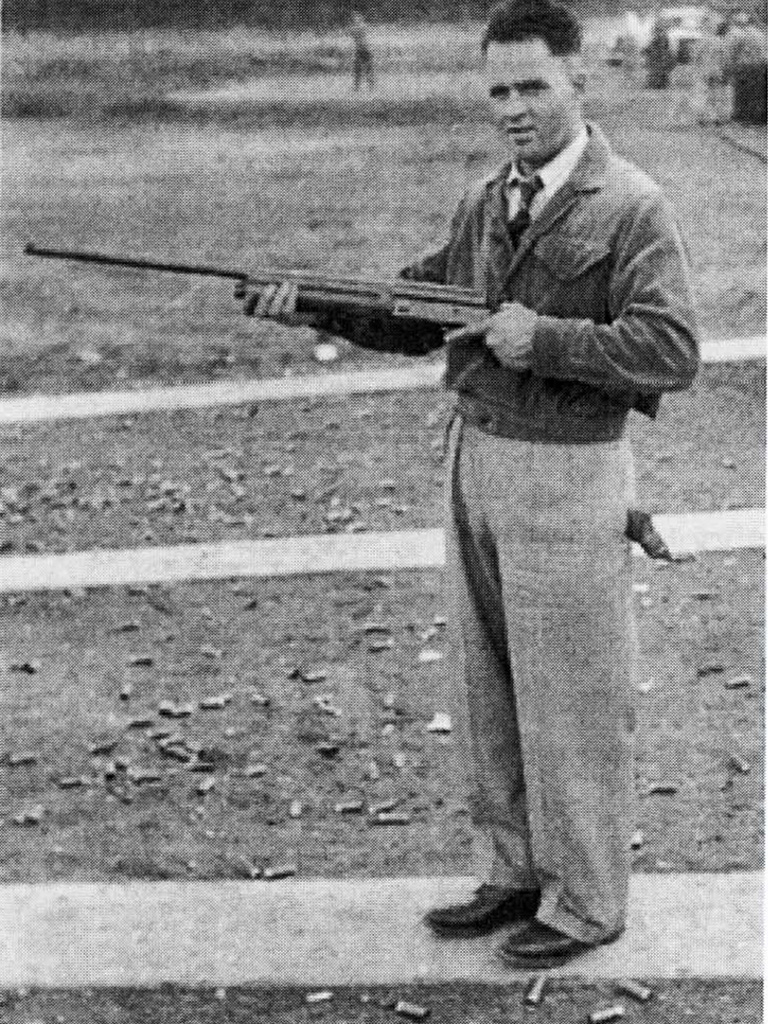
Brother Jack had also followed his passion. An expert shooter he won many awards, among them the Metropolitan Pigeon Shooting Championship in 1941. Throughout the ‘40s he competed in trapshooting and was regarded as one of the greatest shots in Australia. In 1949 it was reported he was also one of the unluckiest – twice he was runner-up in the Champion of Champion events. Altogether he won 80 titles (including Champion of Champions). A colourful figure, he was always prominent in any move to further the sport. He was probably the biggest gambler that the sport of shooting has ever seen and thrived in the live bird competitions of the day. He loved to do battle with the bookmakers and anybody else game enough to wager with him. On one memorable Saturday afternoon, at the old Melbourne Gun Club, Jack was reputed to have won more than £5,000 from the assembled bookmakers. This was enough to have purchased a very comfortable home in one of the better suburbs of Melbourne but, as any gambler knows, you have good days and bad days. He is also reputed to have lost £1,000, his car and his gun, all on the one Saturday afternoon.
The Promising Young Footballer
Jack McCraith was a passionate Essendon Football Club supporter and one of a group known as the “Essendonians” who worked informally to raise money for the club. In 1947, they heard about a promising young footballer at Hastings. Jack and a few other Essendonians went to Hastings to check out the reports and, as history records, John Coleman was signed to play for Essendon. In his first game with Essendon, Coleman kicked a record 12 goals and went on to kick 100 goals for the season. He played 98 games for Essendon and kicked 537 goals. A serious knee injury in 1954 brought his playing career to an end. In 1960 he bought ‘Pindara’ at Arthurs Seat. Coleman started coaching Essendon in 1961, won premierships in 1962 and 1965, but retired from football a year later to concentrate on running the Dromana Hotel. It was there, on 5 April, 1973, that he died suddenly of coronary atheroma, aged 44.
Doug Ackerly’s biography, “Coleman: the Untold Story of an A.F.L. Legend”, contains an appendix of ‘Coleman Myths’. Third on the list is, “He went to Essendon after club patrons raised £500 to buy a tractor for the family farm.” The source of this myth is uncertain but Jack McCraith never refuted the story. The Coleman statue in Hastings was unveiled on 22 September, 2005 by John’s brother, Albert, and daughter, Jenny Goullet. When the tractor story was raised with Albert, he replied, “If Jack has sent a tractor it must be coming the long way round.” With a smile he added, “Mind you, I still glance up and down Hendersons Road each day to see if there is any sign of it.”
Jack’s beach house and farm on the Mornington Peninsula
In 1939 Jack had wed Aimee Small and the couple had two sons, Donald and Colin.
In the 1950s, Jack bought a holiday house in McCombe St, Rosebud. At the time Rosebud was more of a peaceful backwater than the suburb it is today. Family holidays were usually spent here. There Jack indulged his interest in boats. Son, Colin, could never understand how his father, who never learnt to swim, was always putting himself in danger on the water.
In 1956 Jack McCraith fulfilled a dream and bought ‘Boniyong’, a 600-acre property in Browns Rd, Boneo. He also acquired its herd of Poll Hereford cattle. He only had a vague idea of how he would use the farm except to shoot the ducks, quail and snipe that were there. He employed a manager, Eric Terry, to run the property and came at weekends to shoot. (Terry descendants would manage ‘Boniyong’ for the Mc Craiths until 1980). However, Jack soon became hooked on farming and continued to come to the peninsula every weekend. The property became prime grazing land. Jack was training his eldest son, Donald, to follow his footsteps and eventually take over from him. Donald was employed at ‘Boniyong’, starting as a farmhand.
In the early 1960s Jack paid $75,000 for 220 acres on the east side of Boneo Rd, south of Limestone Rd. He put in irrigation and Donald and the manager of ‘Boniyong’, Eric Terry, raised fat lambs there. After Donald’s marriage in 1962 he and his bride made ‘Boniyong’ their home.
Another Potential Champion
Like his father, Donald McCraith was an expert shooter although they were unalike in temperament. Those who knew Donald describe him as “a quiet and humble achiever”. Jack, a hard task-master, believed Donald could win an Olympic medal. On 16 June, 1969 Donald shot 300 out of 300 with a single-barrelled gun at the National Shoots at Geelong and was carried from the stadium in triumph by the other shooters.
“What do you think of that, Dad?” he asked his father.
“It’s fair,” said Jack, “but you’ve got to shoot 500 out of 500 to win a gold medal at the Olympics.”
The next day, Donald McCraith died in a motorcar collision in Hastings. He was aged 27. A few weeks later a letter arrived informing him of his selection for the 1972 Munich Olympics.
Boniyong
After Donald’s death, Jack retained ‘Boniyong’ where he bred Poll Hereford cattle.
At one stage, the cattle developed an eye cancer. Jack asked around and purchased Simmental Fleckvieh bulls to service his cows. This fixed the problem and a comment on the ‘Ten-Rose International Simmental Fleckvieh’ Facebook page describes Jack as a “man with determination.” Barry Toohey who worked for Jack for forty years both in the rabbit factory and at ‘Boniyong’, pulled no punches. “He was an old bastard of a thing to work for.” Jack expected his employees to work hard and demanded their loyalty. In return he repaid their loyalty and was, at times, generous in his support. Despite their arguments Jack and Barry succeeded in becoming very good graziers with ‘Boniyong’s’ vealers topping the sales at Dandenong Market for five consecutive years, bringing in an average of more than $500 a head.
Jack did very well with land on the Mornington Peninsula. One block he bought for $80,000 in the 1960s, to grow lucerne, he sold a few years later for $450,000.
He never sold ‘Boniyong’. Jack had paid £25,000 for it in 1956, and when he was offered $2.5 million for it in 1995, his response was, “Come back and see the family the day after I die. I’m not selling.”
***
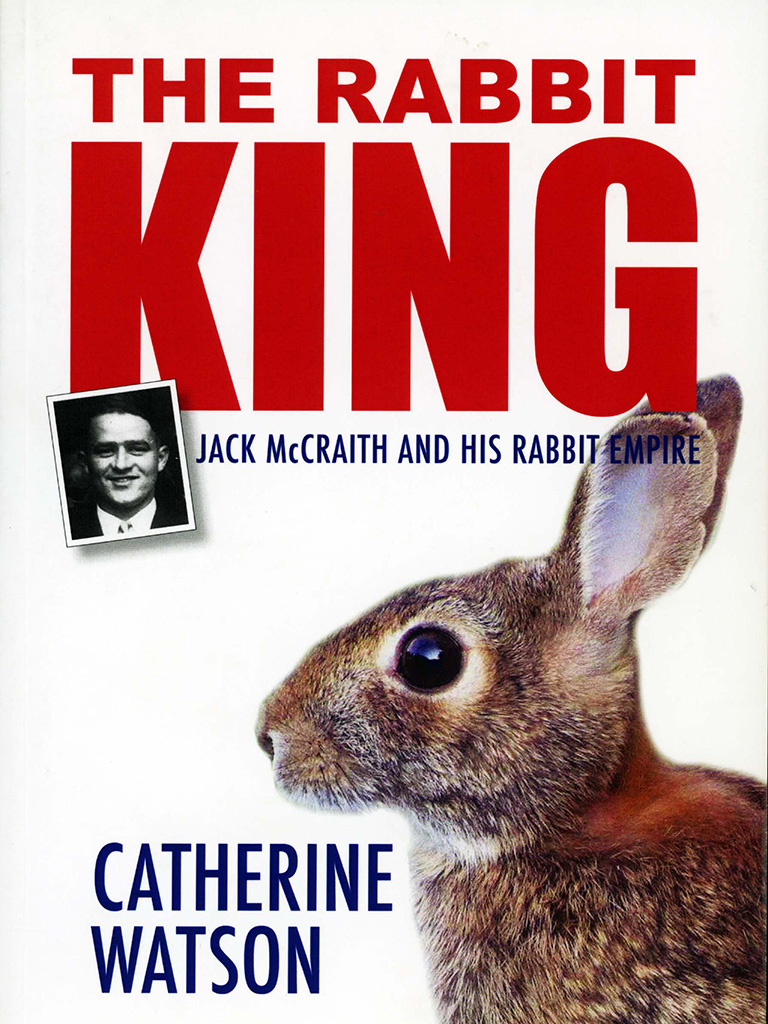
Jack’s story was told in a book titled “The Rabbit King: Jack McCraith and his Rabbit Empire”. Written in 1996 by Catherine Watson, it was paid for by Jack and, according to Barry Toohey, it really says only good things about the man who became a multi-millionaire and controlled the rabbit industry for forty years. Barry added, “He was business savvy . . . one of a kind – he could turn his hand to anything.”
John Andrew McCraith died on 20 April, 2001. He was 84.
More recently a film, “Rabbits”, has been made by Donald McCraith’s grandson, Riley Sugars, which explores the relationship between Jack Mc Craith and his son.
References:
Sources: “The Rabbit King: Jack McCraith and his Rabbit Empire” by Catherine Watson [1996];
“Butterfly House” – ABC Documentary [Nov. 19th 2006];
The Rabbit Industry in S.E. Australia 1870 – 1970;
“Rabbit Trader who loved Orchids”, Bin Dixon-Ward and Kate McNeil (obituary – The Sydney Morning Herald);
Australian Shooters Association Website;
Material from “The Rabbit King” used with permission.
Peninsula Essence March 2024