
By Lance Hodgins
In February 2026 the federal government announced that it would sell off “excess” defence land and raise $3billion. HMAS Cerberus is one target. It sits on a large 1500 hectare site bought by the government in 1911.
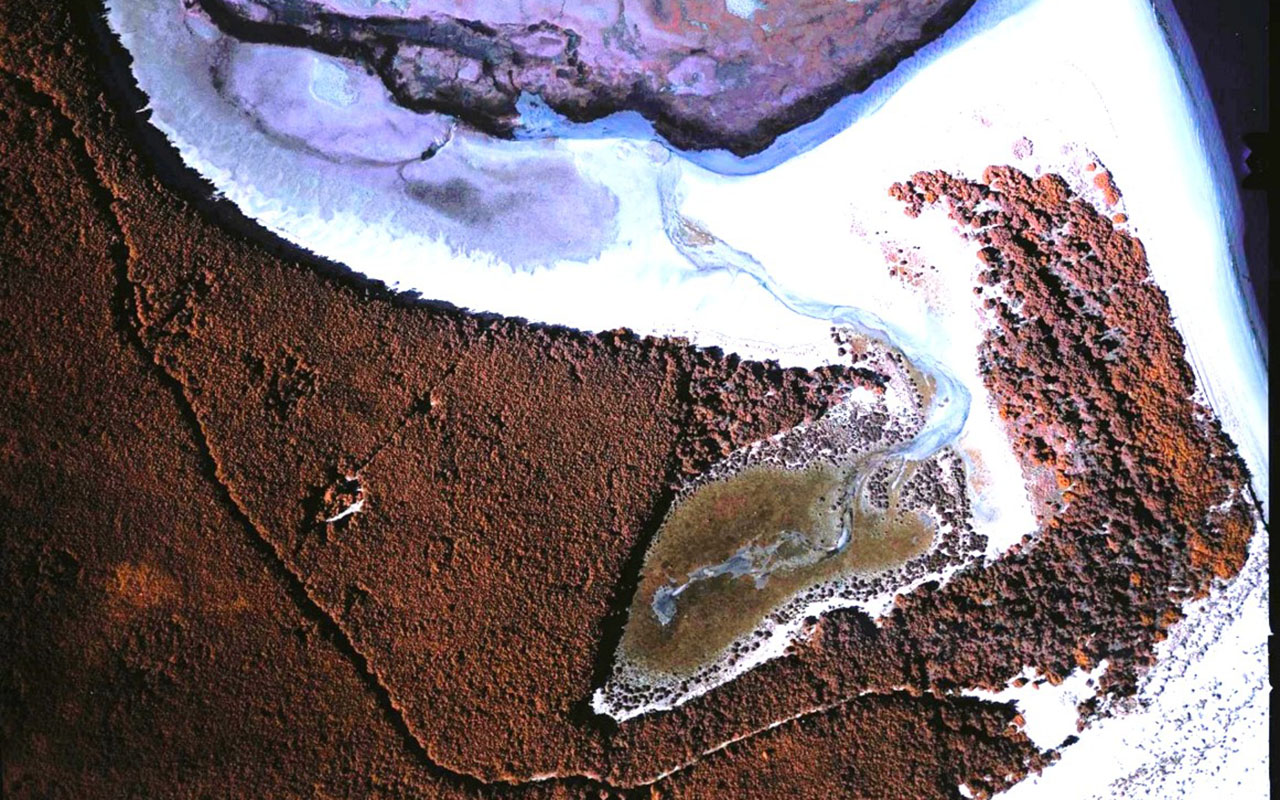
The land surrounds Hanns Inlet between Crib Point and Somers. 1200 hectares of it has remained unused for well over a century and, as a result, it supports a large area of pristine native vegetation and rare bird and plant species.
Furthermore, the southern portion has a coastline of incredible beauty and a rich history.
Nefarious past
“The captain of the ship collects £1 from each of the Chinamen and, when they get into shallow water off Sandy Point, throws, pushes or scares them overboard with a gun.
A terrific shouting, yelling and screaming takes place. People rush about on the deck, some jump overboard, others are pushed. All are in water up to their necks as they wade ashore …
As soon as possible the ship sails away and all is quiet again.”
– Hunter Rogers
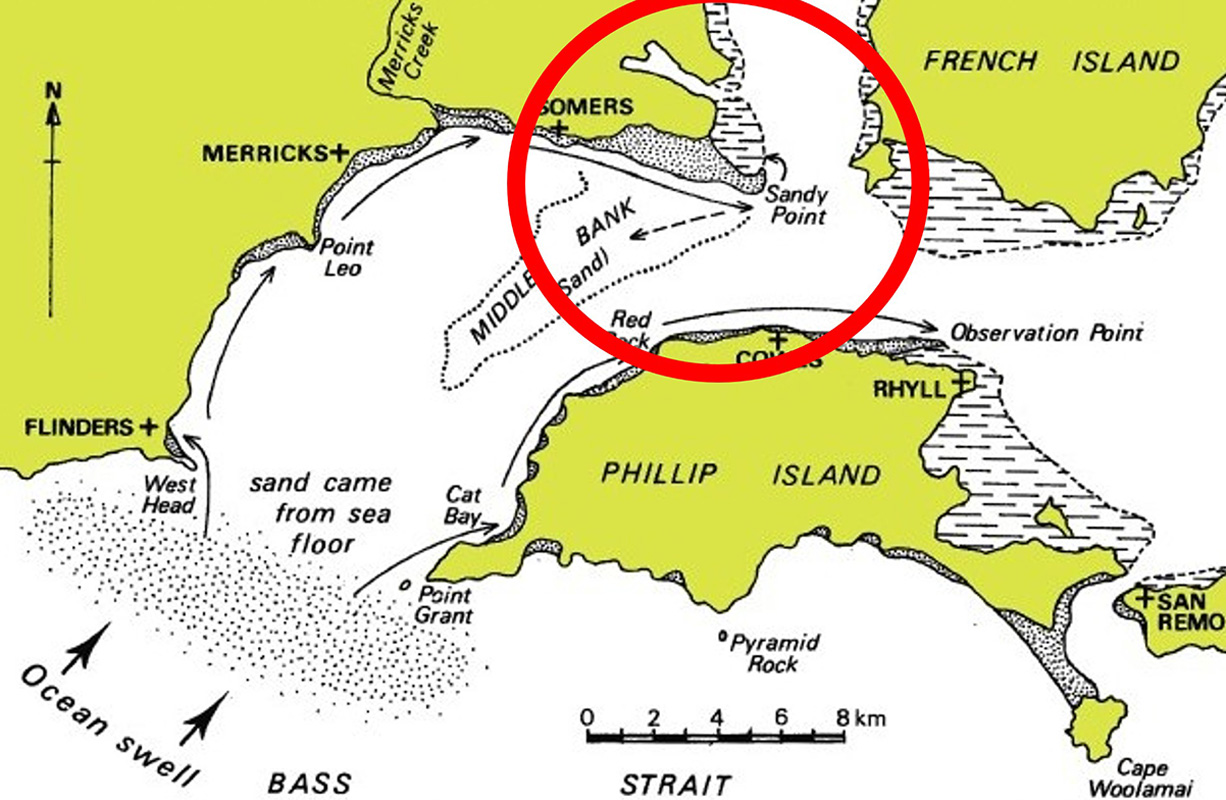
Sandy Point in 1856 was normally a quiet place. The original settlers on Phillip Island, the McHaffies, used the Point as their landing place on the mainland; it had a deep water channel next to the shore and firm sand right up to the water’s edge, and it was a few miles closer than Coolart further along the coast.
The discovery of gold had caused a massive influx of Chinese and, to stem this flow, the Victorian government brought in a tax of £1 per head. Unscrupulous boat operators set out to avoid paying this, however, and up to 200 people at a time were being dumped overboard at Sandy Point and left to make their own way on foot to Melbourne and the diggings beyond.
“One of them became separated from his mates and wandered about the Peninsula for a while. He reached our place in Flinders in a pitiable condition. He had shoes but no socks and his feet were cracked and bleeding. My mother gave him a good meal and some socks …
We directed him along the beach to Coolart where the main body of them had passed to Melbourne … a fair dray track, and anybody would give him something to eat.” – Samuel Tuck, 1856.
The bluestone police station
At that time there were only two police stations on the Peninsula – at Cape Schanck and Schnapper Point (Mornington). A third one at Sandy Point would not only catch any illegal immigrants, argued Joseph Hann of Coolart, but also deter the fishing parties who were stealing his sheep. Hann offered to build one for a little about £100 but this was considered too dear and promptly rejected.
Two years later, and after McHaffie had added his complaints, a police station was erected. It was a magnificent bluestone structure, 27 feet square divided into four rooms with bluestone internal walls and a corrugated iron roof. The fireplace was made of fine imported white clay bricks and there were timber stables at the rear.
The “Fort” or “Stone House”, as it was affectionately known to the locals, was built just around the point which meant that incoming ships could not see it until they were right upon it.
Constable Louis Julius Weidner was appointed as its occupier. He was a tall and intelligent 31 year-old German with a reputation for being conscientious and fair. He was only needed there for two years. It became increasingly obvious to the authorities that South Australia was more lenient to the Chinese, whose numbers had begun to decrease in any case.
The Sandy Point police station was abolished in June 1862. The building was put up for sale but there were no takers. It was rented for 3/6 a week to Mr Putwain of the Oyster Company and then it was sold to a Lawrence Rostron for £26.
Enter Lawrence Rostron
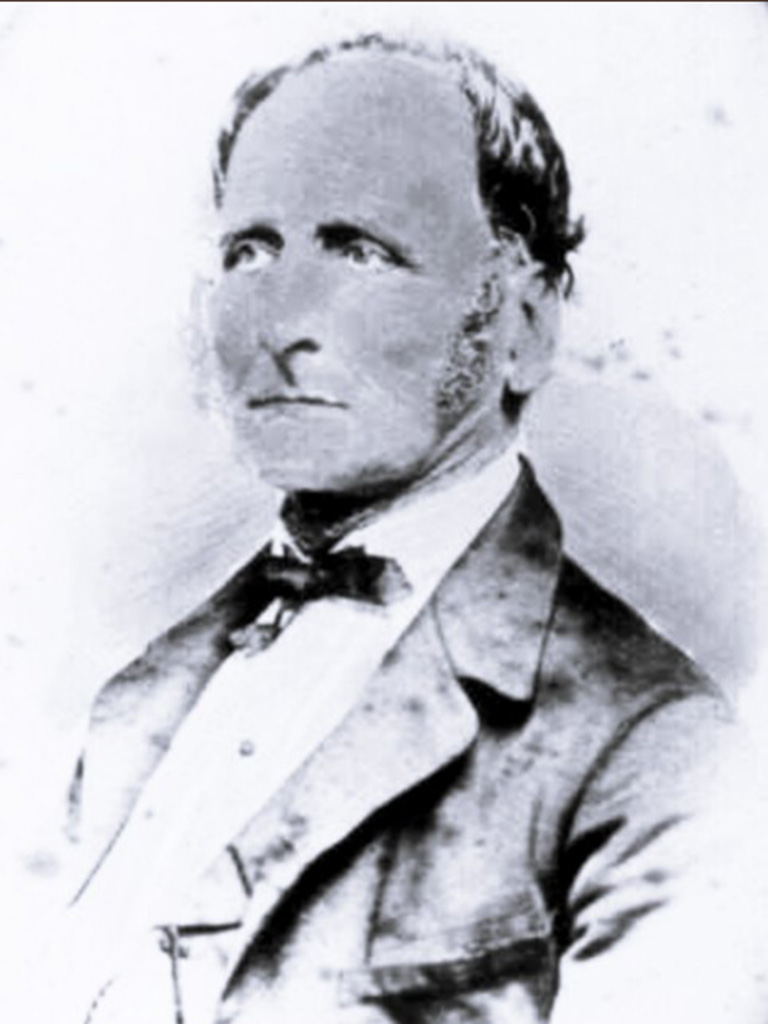
The 63 year-old Rostron was a most influential figure. Born in Lancashire to wealthy parents, he had been sent to Brazil to manage the family’s business. Whilst there, he amassed a small fortune and he decided to emigrate to Australia in 1842 and start a new life. Rostron became a hotelier, merchant, shipowner and a grazier controlling over 200,000 acres.
In 1860, he saw an opportunity at Western Port, which had once been a productive source of oysters before being over-fished. A scheme to establish artificial oyster beds at Sandy Point was being promoted by a former Inspector of Fisheries, James Putwain, and Rostron decided to invest. The company spent £20,000 on dams and containments before operational problems arose and the venture folded. The loss was unsustainable for Putwain but his partner, Lawrence Rostron, would survive the loss.
Rostron’s interest in Western Port had been aroused. In August 1864 he bought Crown allotments 150 and 151 – 308 acres at Sandy Point which included the old police station.
He had plans for a township covering 39 acres at the Point. There were 15 lots from one to three acres and a nearby reservoir which was all that remained of Putwain’s oyster beds.
When the lots were put up for public auction, their reserve prices ranged from £3-4 per acre and all but one were sold. A few people bought multiple lots: one wealthy Moonee Ponds widow Eliza Alice Sparkes bought three, land and shipping agent H Smith bought three, politicians T Loader and R Anderson bought five between them, and merchants J Lord and H Howard one each.
The speculators had obviously moved in and no houses appeared. Henry Howard was the only one with a business interest in the area – he owned a hotel in Mornington and ran the mail coach through Hastings to Phillip Island. He would have used the jetty on the Point which had been providing the vital link with the Island.
A second jetty
In anticipation of the “township sale”, an enterprising farmer named James Gordon obtained a 3 acre lease on which to build a jetty – further up the inlet and closer to his own 283 acre farm. This site would be more easily reached and better sheltered than the Point. Public support was lacking, however, and the venture had limited success.
For a short while the jetty served as an outlet for cleared timber. At one stage, over 70 tons of wood were stacked on the wharf to be sold by Gordon at 3/6 per ton up front. Negotiations had been stalling with a particular trader named George Goble who quietly returned, loaded up his schooner, and set sail for Williamstown. He managed to sell his ill-gotten cargo but the theft earned him a hefty prison sentence.
In any case, the two jetties at Sandy Point would never have lasted long. When the “defense” railway was completed to Stony Point in 1889, Western Port traffic became focussed on the other side of Hanns Inlet.
The “camping ground”
Just inland of Gordon’s jetty, there were 1,000 acres that remained in government hands. Six allotments were originally set aside by the Crown as a holding area for sheep waiting to be transported to and from the islands of Western Port. This was called the “camping ground”. When not being used for this purpose, others could apply for a grazing licence.
The grazing licences attracted interest from Coolart and the more distant Tuerong station. This arrangement proved to be a constant headache over the next ten years. With Rostron on one side of this area and eager graziers on the other, there were fiery arguments over licences, illegal occupations, and disruptive clashes with the “campers” – who were accused of rarely being there in any case.
Finally, in 1884, the Phillip Islanders convinced the government that the area had originally been set aside for their own special use, and the grazing licenses to others were abruptly stopped.
The Rostron family continued to hold on to their land at Sandy Point. Old Lawrence had died in 1877 and his widow went back to England with their son, Lawrence jr, who studied for his law degree. He returned to Australia in 1906 and joined a law firm in Queen St Melbourne. He offered his services to the towns of the Peninsula on a rostered basis, and is believed to have stayed in the old bluestone police station at Sandy Point.
Western Park
On the other side of the Camping Reserve lay Western Park where, during the 1870s, James Teasdale developed a significant agricultural holding. Teasdale had been the farm manager at Coolart and he wasted no time in applying his skills to his new property.
A massive 150 acres were cleared. The swampy flats were turned into well-drained paddocks of potatoes and mangles for winter fodder, and the hillsides grew quality oaten hay for his prized Shorthorns.
After ten years Teasdale turned to sheep and developed a flock of one thousand purebred Lincolns. He built a substantial brick home on an elevated site which gave him incredible views over Western Port. Beyond his boundary, the tongue of land at his feet stretched out through the old camping area to Sandy Point. In the years that followed, Western Park had other owners but it still remains largely intact, on the edge of the residential area of Somers.
The Navy buys in
In 1911 the various State colonial navies were amalgamated into the Royal Australian Navy and Western Port was chosen as the site for the national base. Flinders Naval Base had grand plans for torpedo, gunnery and telegraph schools, as well as a wireless station, submarines, destroyers and a barracks for 2,000.
The State Government offered some land but this was deemed inadequate and 1,600 extra acres of private land around Hanns Inlet was compulsorily acquired. On the Sandy Point side this included property belonging to graziers Beaton (870 acres), Mairs (209 acres), Lawrence Rostron jr (171 acres), and numerous small holdings at Sandy Point totalling 31 acres.
The solicitor Rostron was far from happy with his compensation deal and took it to the High Court, claiming that his land was worth much more than the £850 on offer from the government. He argued that the future residential value of the incredibly attractive Sandy Point made it worth well over £20,000. The judge agreed with his reasoning – but not his amount – and gave him £1,432.
Building had already begun at the base, but it was eight years before Flinders Naval Base was officially opened in 1920. By then, WW1 was over and plans for the submarine and torpedo functions were dropped. The base was downgraded to the smaller status of a Depot.
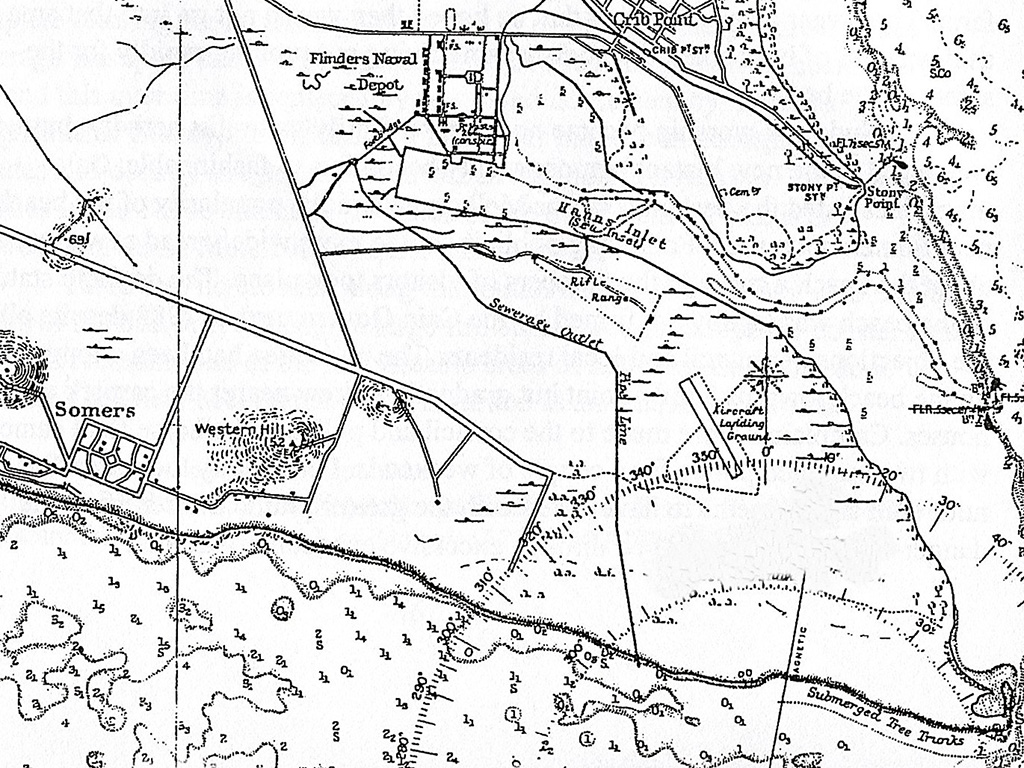
Nevertheless, there were soon several hundred recruits in training and more facilities were needed. These were all built at the head of Hanns Inlet, leaving the majority of the land as an unused buffer zone – which was fine for security since it kept the public at arm’s length.
One hundred years of naval activity
Over the next few decades, the human impact on Sandy Point was minimal. One of the earliest structures was a flag mast erected about a kilometre in from the Point. Over 100 feet tall, it could signal ships off Cowes which were out of sight of the naval base itself. It lasted until the 1960s.
Not so permanent was the old “trig” station – a 40 feet high wooden structure used in the recharting of the Bay. It stood 50 yards back from the water’s edge but rough weather and high tides in 1922 eroded much of the foreshore and destroyed its base. This was a timely reminder that the coastline at Sandy Point was an ever-changing one.
The old police station had been briefly inhabited by Lawrance Rostron, after which it was allowed by the Navy to fall into disrepair. In 1928 it was finally demolished and some of its bluestone was used in the main gates of the base as well as some fencing between the officers’ homes.
A rifle range was built on the south shore of Hanns Inlet, with a caretaker’s residence nearby to discourage unwanted visitors. Firing took place in an easterly direction towards Sandy Point which became famous for its unexploded ordinance as, on more than one occasion, some adventurous boy would return home with a “find.”
During World War Two there were plans for an aircraft landing strip and an area was cleared to the south east of the rifle range. It was never used and soon became overgrown. A concrete pillbox gun emplacement at Sandy Point is still there but it, too, is now well-covered in vegetation.
Nevertheless, there were, “invaders” of a different kind. Escapees from the nearby French Island prison farm would occasionally try their luck in that direction. In 1955 three prisoners landed at Sandy Point and made for the rifle range, where they were apprehended by fifty sailors and fifteen police armed with submachine guns, rifles and pistols.
Fortunately, the area experienced few bushfires. However, in 1942 a large one swept in from Western Park and was allowed to burn itself out by reaching the coast near Sandy Point. The Navy has since maintained access tracks throughout the area, the main one picking up the old road about halfway to the Point. Although it is kept well cleared it remains little more than a sandy track with a very unstable base.
A sewage outfall was put through the old camping area and into the sea. More recently, concern was raised over pollution from PFAS – the “forever chemicals” left over from fire-fighting foam used in training on the base. Some contamination was found in the area under investigation, which included the inlet but not the Sandy Point peninsula.
Sandy Point today
After a century of naval ownership, Sandy Point and its hinterland contain the largest remaining intact vegetation on that side of Western Port. There are substantial areas of original growth coast banksia, and manna gum woodlands which until recently supported 1500 koalas.
The old-growth trees and hollows have viable populations of sugar glider, echidna, swamp wallaby and the vulnerable white-footed dunnart and endangered southern brown bandicoot.
A large and varied bird population includes many woodland species which have become rare on the Mornington Peninsula. The internationally recognised Ramsar Wetland borders the site and is on the flyway for migratory birds, including the endangered common greenshank, the critically endangered red-necked stint and eastern curlew.
The area is large, has suffered minimal human impact for a long period, and supports a great number and variety of species. Conservation groups such as The Westernport and Peninsula Protection Council believe that it fulfils all government criteria for biodiversity protection, research and education.
Many thanks to Bruce Bennett for allowing use of material from his books “All our Somers”, “Morradoo” and “Stony Point”. All are available for purchase through the Hastings-Western Port Historical Society on 0490 132 011.