
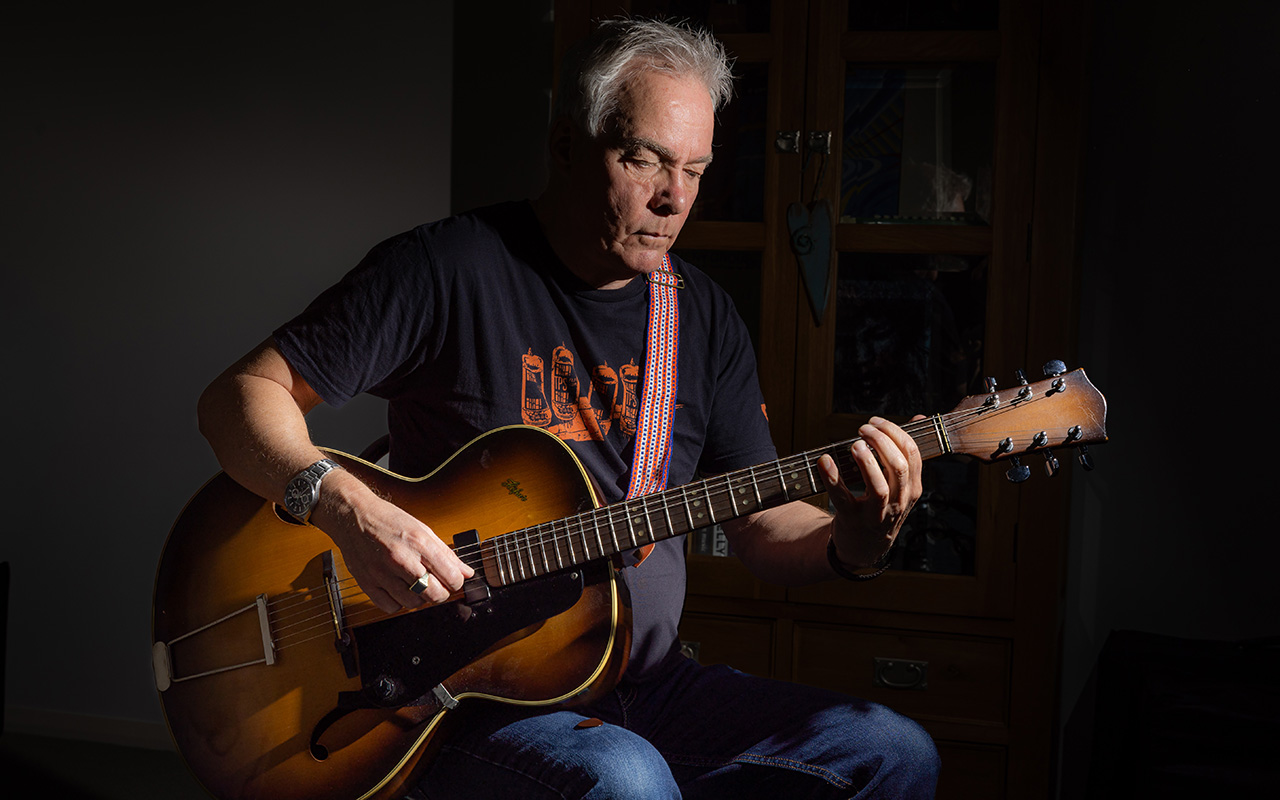
Growing up in a house full of music it’s no wonder Frankston-raised Bob Wijnschenk also developed a love for it. And now, after a long career of playing gigs and teaching guitar at public schools in and around the Mornington Peninsula, 72-years-young Bob has released his second album, The Wine Pourer’s Tales, which he explains is a “personal exploration of love, loss, family, friendship and hope.”
Bob recalls, “There was always music around, either from the radio, record player, a musical on TV or from my sister Carla’s room. She loved singing and had a smooth Ella Fitzgerald style and tone to her voice.” Bob’s dad, Simon, did regular sit-in performances singing for the house band at The Dutch Club in Carnegie from mid to late 1960’s. “He had a great natural singing voice and always sang at family parties,” said Bob. “I loved listening to him.”
And though Bob’s dad never officially played guitar as part of a band, he often practiced at home in the kitchen while Bob was all ears and loving the sound.
At age 15 Bob started playing his dad’s 1959 Hofner acoustic guitar. His love of playing stayed with him through high school where the sound of the Fender Stratocaster guitar and the emerging Jimi Hendrix and Eric Clapton heavily influenced his playing and early song writing.
Through our love of music we all just gravitated toward each other
In the early 1970’s Bob’s first “serious” bands formed. Shagrat and then Outburst played an Indie mix of originals. With Bob on bass, three of the other members came from The Pines and the other two members lived in Frankston and Seaford. Bob said, “Through our love of music we all just gravitated toward each other.” Their vocalist had a “killer voice”, and the band did a few stints on Channel 9’s
New Faces.
Bob eventually left Outburst wanting to focus on playing lead guitar. During this period, he wrote many songs and started to develop his own distinct style. He moved to Perth for “sunshine, girls, friends and a fresh musical journey” as a self-taught muso.
After Perth, Bob moved to the Latrobe Valley and joined a band of seasoned players doing covers. Bob values this time of musical growth where he learned a lot from the other band members about playing true to a style of music rather than doing your own thing. “They also introduced me to plenty of country music,” said Bob.
In the late 1970’s Bob moved to Brighton and worked part time as a cleaner. “I cleaned some of Melbourne’s top recording studios at the time such as Sing Sing Studios in South Melbourne and would often try to ‘breathe in and tap in’ to the vibes of the studio,” he said. Once, a song idea sparked in his head and as soon as he got home he started to woodshed it. That song was called Australia-Be A Part of It which morphed into an anthemic song which his sister, Carla, and he recorded. This song would go on to become runner up in the City of Kingston Bicentennial Song Contest.
When Bob was in his mid-30’s he met a well-known Melbourne jazz singer named Pippa Wilson who encouraged him to learn to read music. She suggested teacher Bruce Clarke, a key figure in Australian music. Bob studied with Bruce for five years and another five years with some of Melbourne’s top jazz guitar players at the time such as Doug de Vries (Steve Vizard show) and Piere Jaquinot.
Taking music theory more seriously, his jazz phase was a tremendous learning curve for him in terms of understanding music theory, harmony and later, most importantly, melody. It was during this period he was introduced to Pat Metheny, the great American jazz guitarist and composer. Pat’s Bright Sized Life album had a huge impact on Bob and had great bearing on his song writing style. His compositions became more layered and often featured complex harmonic progressions reminiscent of jazz. His instrumental Beyond this Life is a case in point.
At 45 years of age Bob attended Latrobe University as a mature age student and received a Bachelor of Music followed by a Diploma of Education at the University of Melbourne. Whilst at uni he was forced to become computer literate which opened a new world of opportunities such as notation and recording programs to write and create music. “All of a sudden I had every conceivable instrument’s sound at my fingertips via MIDI (Musical Instrument Digital Interface) which allowed me to move away from the guitar a little and venture into richer and broader instrument choices and arrangements,” he said.
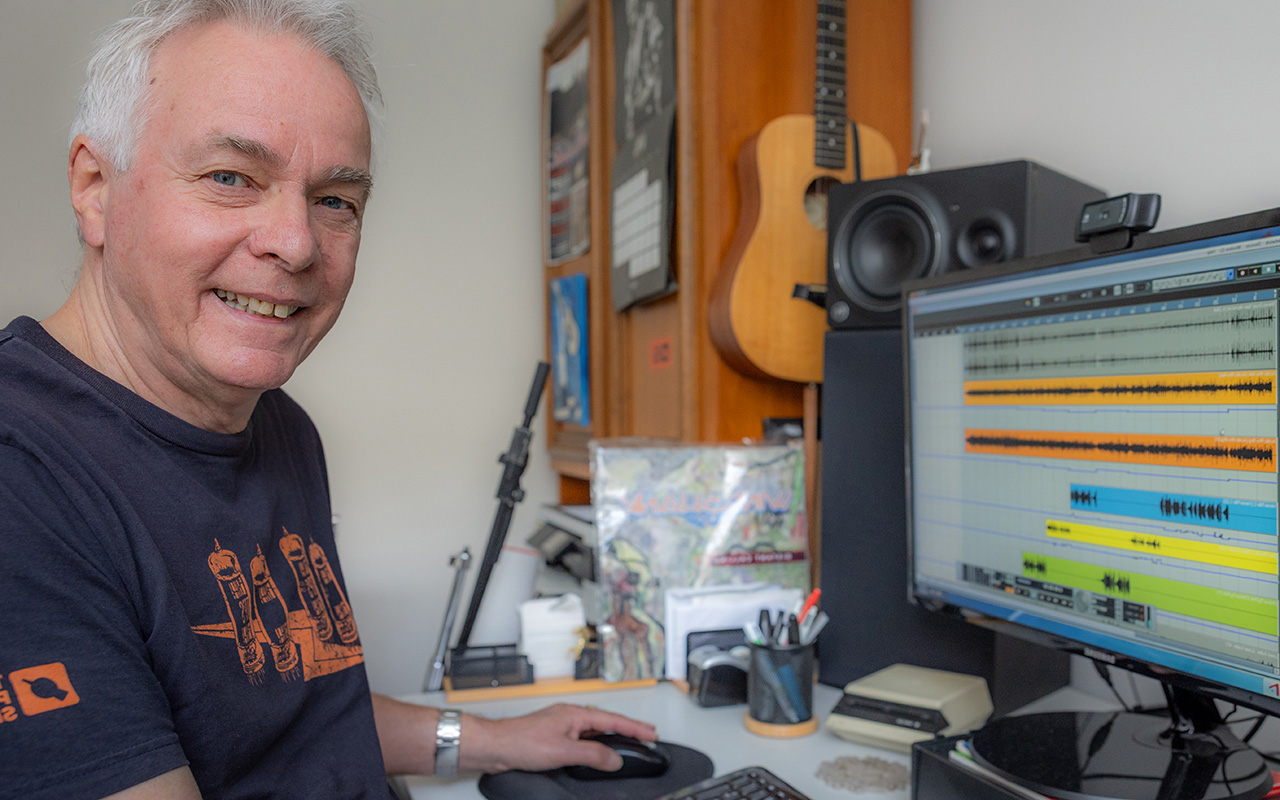
After uni Bob worked as a guitar and bass guitar teacher all over Melbourne and the peninsula including Mornington Secondary College and Frankston High School, all the while playing in bands and focusing on writing music. His highlights from teaching were working with guitar ensembles and performing with them at concerts. “It was always a lot of fun. At one concert we played an all-guitar version of Bohemian Rhapsody which I conducted, although very badly, but it brought the house down!”
Other influences that made Bob the music alchemist he is today are Brian May (Queen) and Sting. Much of Bob’s legato style of playing was inspired by Brian May’s smooth-toned lead lines on early Queen albums. The intro and outro solos of Roo Girl, penned by Bob on his newest album, features this style of playing.
It was at the start of the 2000’s that he started going under the new name of Wineshank (a play on Bob’s Dutch surname Wijnschenk which literally translates to ‘pouring wine’). From that time on every recording came under that moniker. Wineshank’s songs form colourful tapestries of chords, riffs and melodies that surprise and arouse fragile, heady experiences blending real-life experiences with abstract fictional storytelling. Roo Girl is the tale of a girl protected by kangaroos in the Australian scrub, and Shadow is a complex dynamic between mother and son.
The Wine Pourer’s Tales marks a sonic shift from Bob’s debut album Distant Calling which dropped in 2017. Different from the raw and edgy format of his first album, Bob dug deep into the creative process by tapping into some hidden emotions. He also focussed heavily on rich guitar tones, utilizing the Roland VG-99 (advanced V-Guitar system and multi-effects processor) and open tunings to craft unique, melodic textures. The album has seen collabs with many incredible artists from overseas as well as here in Australia.
“Developed over seven years, I really wanted this collection to create surprising, engaging moments for the listener.”
Find more of Wineshank’s music on Spotify and all major streaming platforms.
W bobbyshank.bandcamp.com/album/the-wine-pourers-tales
W wineshank.com
Peninsula Essence July 2026