
By Peter McCullough
The March edition of Peninsula Essence recounted the drowning tragedy which befell the O’Donnell family on Christmas Day 1905. Eight members of the family travelled down to Sorrento to celebrate the occasion but only four returned to their home in Malvern. They were the mother Sarah (who was 45 when the tragedy occurred), Hilda (19), Dorothy (14) and Stanley (who was 16).
How did the O’Donnells fare in the ensuing years? Sadly, further misfortune lay ahead: on 19 July 1916 Private Stanley Richard O’Donnell was killed on the Western Front in the Battle of Fromelles.
Post 1905
Following the Christmas Day tragedy life was a battle for Sarah and the three surviving children. Stanley, the only surviving male, was left with the responsibility of supporting his mother and two sisters.
World War 1
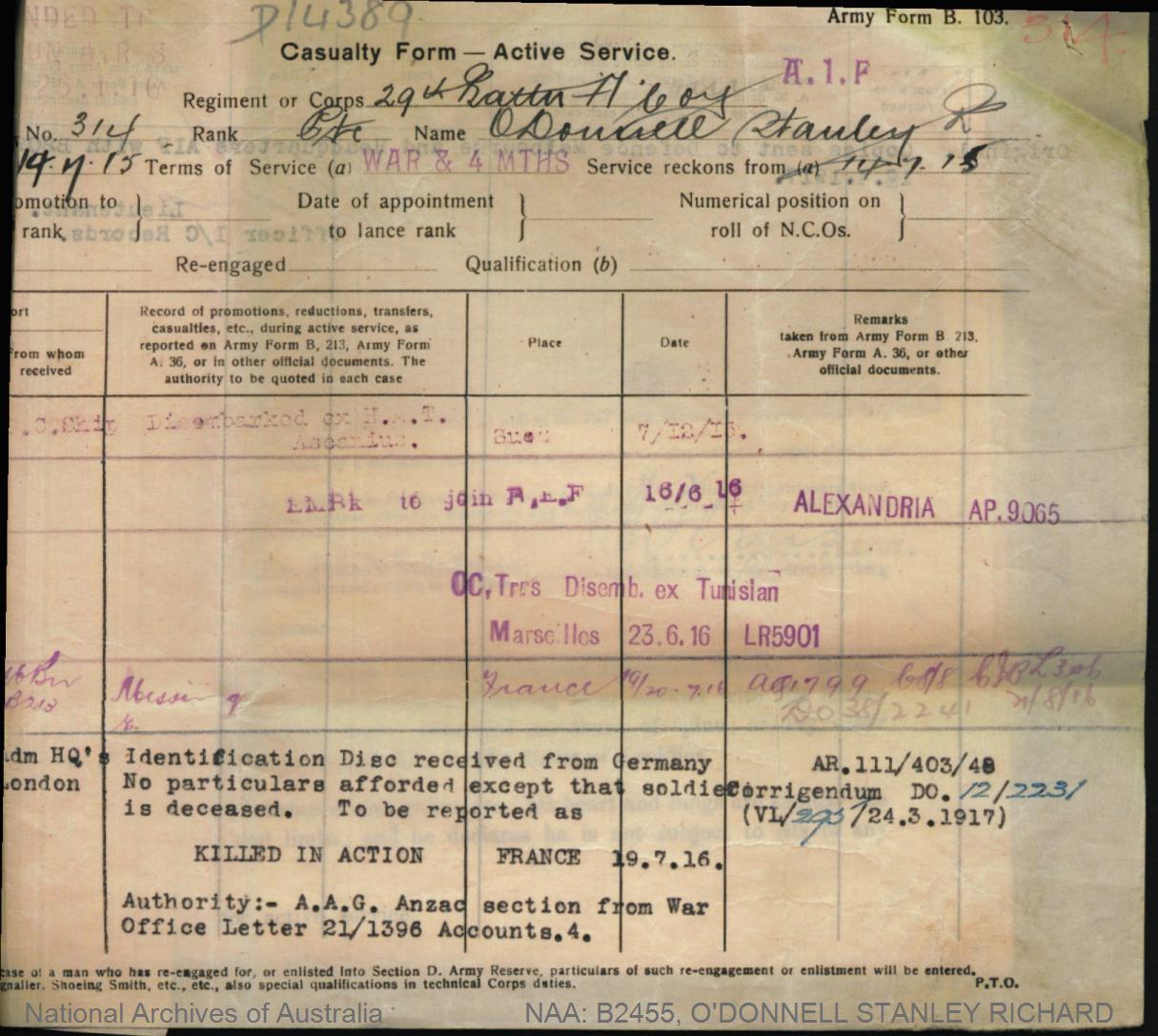
Born and educated in Armadale, Stanley was still living with his family in Malvern and working locally as a warehouseman when he enlisted in the AIF on 14 July 1915, some ten years after the death of his father and siblings. After initial training Private O’Donnell (Regimental No. 314) embarked on the troop ship Ascanius for Egypt with the 29th Battalion, arriving in December 1915. The battalion trained and served there for six months before heading for France in June 1916.
Stanley’s first encounter with the Germans was the disastrous Battle of Fromelles on 19 July 1916; he was subsequently posted as “missing”. A statement was given to the Red Cross by a fellow soldier from the 29th Battalion (Private James Westwood) who was wounded at Fromelles. He stated: “…on the night of July 19-20 at Fromelles he saw O’Donnell, whom he knew personally, hit and afterwards saw his body lying there. He is quite sure from personal knowledge that O’Donnell was killed.” (AWM: Red Cross Wounded and Missing Files)
The statement by Private Westwood notwithstanding, it was not until Stanley’s name appeared on the German Death List in February 1917 that he was officially found to have been killed in action on 19 July 1916.The family notice subsequently appeared in The Argus on 4 April 1917.
Stanley’s mother, having lost the last of her sons, was granted a pension of two pounds a fortnight. As next-of-kin she received Stanley’s identification disc but no other personal effects were returned.
Post War
After the war Stanley’s service medals – 1914-15 Star, British War Medal and the Victory Medal – were issued to Sarah in addition to the memorial plaque and scroll.
Stanley’s sisters, Hilda and Dorothy, both married but only Dorothy had any family..
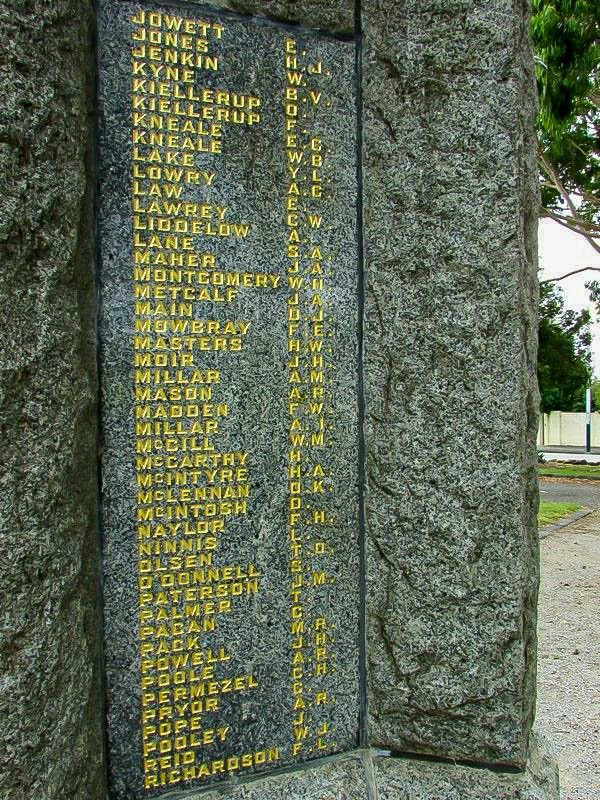
Stanley’s name is recorded on the Malvern War Memorial – a beautiful granite memorial in the shape of a Victoria Cross – which is located in the Malvern Cricket Ground.
Later Developments
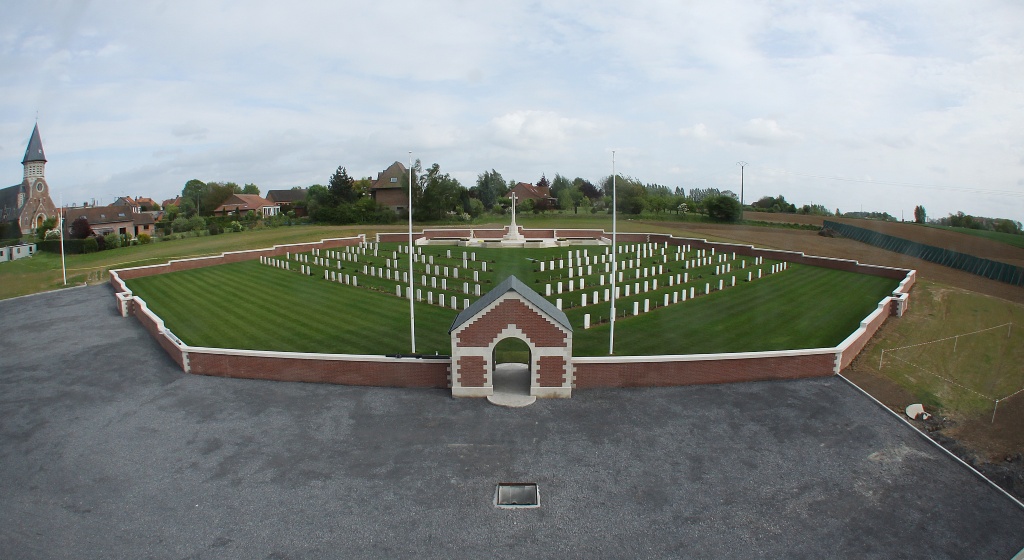
Research early this century led to the discovery of a burial site at Pheasant Wood and the exhumation of the remains of 203 Australian soldiers. Rigorous DNA testing led to the identification of almost half of that number, including Stanley O’Donnell. He was subsequently buried in the Pheasant Wood cemetery at Fromelles where his headstone inscription reads: “He gave up his life that others may live a better one.”
Battle Of Fromelles. 19-20 July, 1916
This brief but heroic action was fought when the murderous Battle of the Somme had been raging for almost three weeks. The attack at Fromelles was a feint to stop the Germans sending troops south to reinforce their battered comrades on the Somme, and the Australian 5th Division and British 61st Division were selected for the attack. The action was poorly planned, slapdash in its execution and the outcome was horrendous. In 14 hours of bitter fighting the 5th Division lost 5533 men killed, wounded or missing, and ceased to function as a fighting force. Almost 2000 were killed in action or died of wounds and some 400 were captured. It was the worst 14 hours in Australian Military history with the losses exceeding our combined losses in the Boer War, Korea, Vietnam, Iraq and Afghanistan.
The Australians had to cross over 200 metres of open ground in broad daylight to reach the German line which was on higher ground (the Sugarloaf salient). A few made it through, only to be cut off, captured or killed as they tried desperately to return to the Allied trenches. From no-man’s-land came the haunting cries of the wounded or dying. One young Australian, blinded by his wounds, staggered about in no-man’s land and cried out for several days. His mates called out to him and vainly tried to direct him back to the Australian lines until the Germans mercifully shot him. Although ordered not to, many Australians crept out to rescue mates. In fact as many as 30 Australian soldiers were killed in the days afterwards trying to retrieve the wounded and the dead.
The 5th Division was made up of new recruits with a sprinkling of Gallipoli veterans. Those killed ranged in age from 43 down to Private John Gordon who, at 15 years and 10 months, was the youngest recorded Digger to be killed in action. Also killed were five VFL footballers including George Challis who, only ten months earlier, helped Carlton win the 1915 premiership at the MCG.
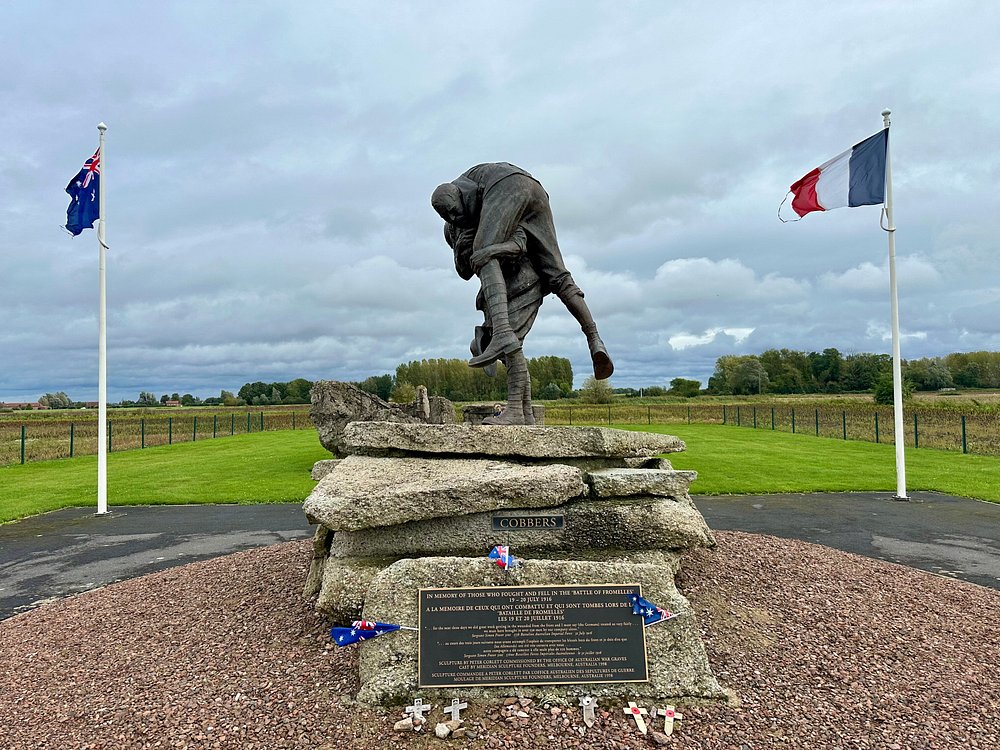
Soon after the war remains of Australian soldiers scattered across the old no-man’s-land were gathered to construct VC Corner cemetery, the only entirely Australian cemetery in France and the only one without headstones. For nearly 80 years this sombre monument remained the only conspicuous reminder of the tragic events of Fromelles until, in July 1998, a new Australian Memorial Park was dedicated nearby. It contains the stark remains of four German blockhouses and the emotive ‘Cobbers’ statue, the work of Melbourne sculptor Peter Corlett. This depicts Sergeant Simon Fraser carrying a wounded comrade to safety. During one of several trips into no-man’s-land Fraser heard a weak voice call out: “Don’t forget me, cobber.” The expression came to symbolize the bond of mateship that held the Australians together in those terrible days.
Until recent years 1,335 Australian soldiers remained ’missing’ from the Fromelles battle. Then rumours that there was a mass burial site at nearby Pheasant Wood caught the attention of retired Melbourne teacher Lambis Englezos who had a long-standing interest in military history.
His initial approach to the Australian Army history unit was not well received; they could not believe that the post-war recovery units would have missed such a mass grave. However, in 2006 a German document dated 21 July 1916 came to light; it ordered the construction of mass graves for 400 ‘English’ soldiers behind Pheasant Wood. This was confirmed by a geophysical survey the following year, and by 2009 a team had commenced the excavation of skeletal remains and artefacts buried in thick, sticky clay.
The end result was that 250 soldiers were found, 203 of whom were thought to be Australian. With the assistance of families who lost relatives at Fromelles, DNA testing enabled the authorities to identify 119 of the Australian soldiers, including Private Stanley O’Donnell.
Heaped into the six burial pits were at least 18 Victorians, from inner-city Brunswick, South Melbourne and Northcote, suburban Canterbury, and from regional Bunyip, Nhill and Alberton. They were postal workers, plasterers, butchers, grocers, stonefitters and farmers, looking for adventure and keen to travel the world. One pit revealed two brothers-Samuel and Eric Wilson-lying side-by-side; whether it was coincidence or compassion no one knows. The Wilsons were one of 26 pairs of brothers killed at Fromelles; two father-son combinations also lost their lives.
The first new Commonwealth War Graves cemetery in 50 years was established on land opposite the church at Fromelles and on 30 January 2010 the first of the burials took place. On 19 July, the 94th anniversary of the battle, the last of the 250 soldiers was buried with full military honours.
FOOTNOTE: A runner for the 16th Bavarian Reserve Infantry Regiment which was entrenched at the Sugarloaf when the Australians attacked on 19 July was a small man with a curious moustache. He was the son of an Austrian Customs Officer who had been born out of wedlock with the name Alois Schicklgruber which he later changed to Hitler. The whole course of history could have been different if young Adolf had stuck his head above the parapet and an Australian bullet had found its mark in 1916. Come to think of it, things may have been different if Adolf’s father had not changed his name; “Heil Schicklgruber” does not have the same ring to it!