
By Ilma Hackett – Balnarring and District Historical Society
Puffing Billy and Cherrydale; there is seemingly little to link the iconic railway line in the Dandenongs with a cherry orchard in Merricks
But one name is common to both – Nobelius.
‘Cherrydale’ is established
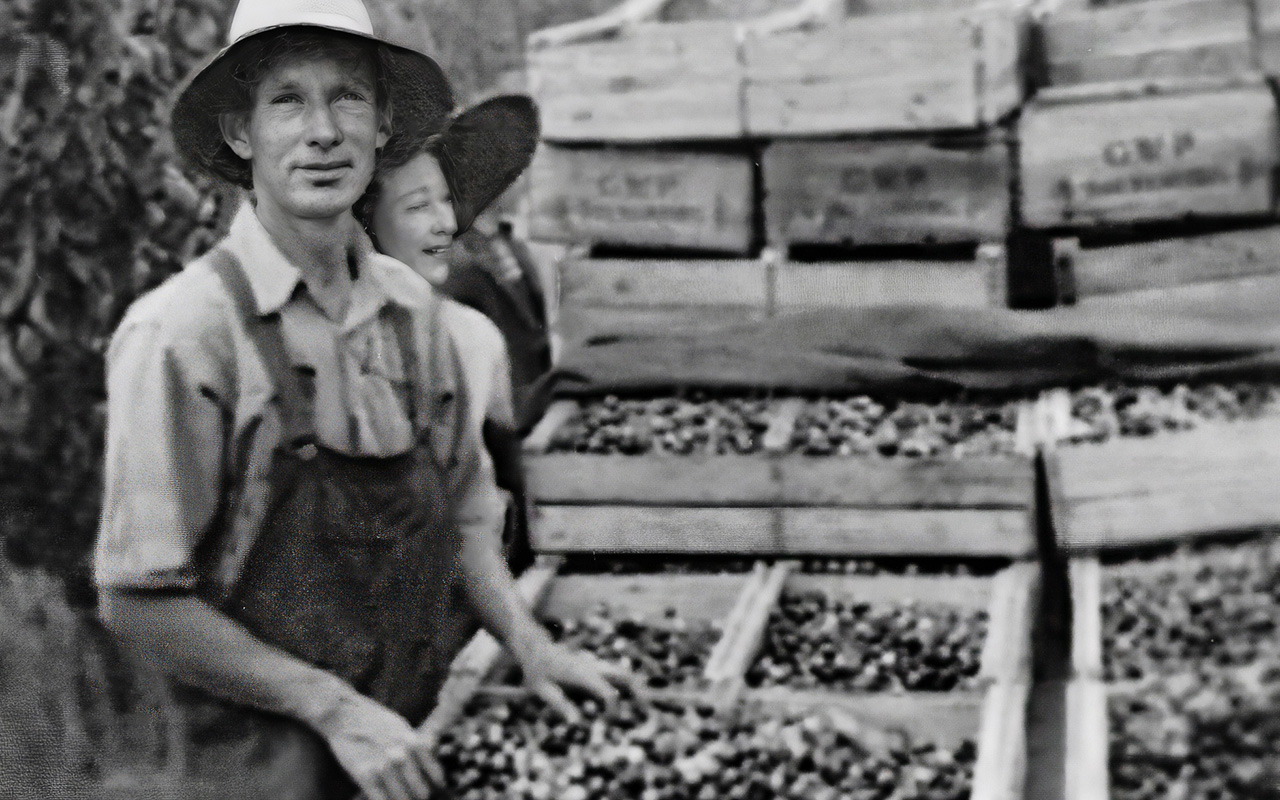
Most people knew Ron Nobelius as “Nobby”. In 1938, accompanied by his wife Amy and their three young daughters, he had come to Merricks to take up the position of manager of ‘Cherrydale’. This was an orchard on the north-west corner of the Bittern-Dromana and Balnarring roads and, as the name implies, it grew cherries. However, apples, pears and peaches were also grown for local markets and part of the property was used for grazing dairy cattle. The owner, G.W. Peart was a Bairnsdale horticulturalist who had a deep knowledge of fruit culture. He had bought the property in 1929 and established an orchard. In the 1930s he planted cherries on forty acres and a mixture of fruit trees on another fifteen acres. He sought a manager to run the orchard and took on Ron Nobelius.
In 1947, nine years after Nobby was hired, Peart sold his Merricks property on, what the newspapers called, “most liberal terms”, to two of the men who worked for him. One was Henry Johns who acquired about 140 acres; the other was Nobby, whose 120-acres share of the land included the cherry orchard. During the period that they lived at ‘Cherrydale’, the Nobelius family became well-known members of the surrounding community.
An ancestry of orchardists
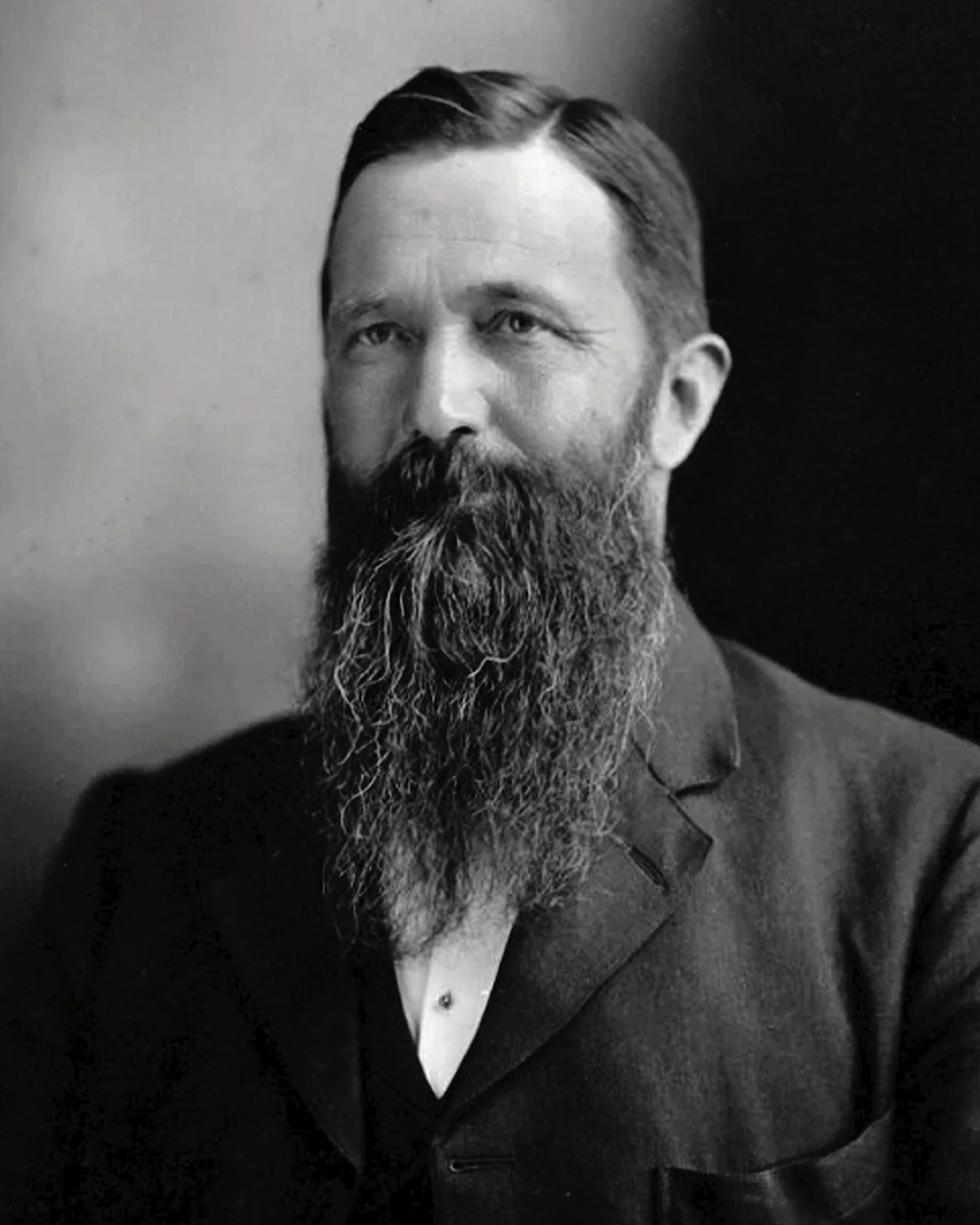
It was almost inevitable that Ron Nobelius should become an orchardist. He was descended from a long line of horticulturalists who, by heritage, were Swedish. His grandfather, Carl Axel Nobelius, an orchardist and nurseryman, had been born in Tampere, Finland. Carl Axel’s parents, horticulturist, Carl Petter Nobelius and his wife, Lousia, had moved there from Gefle in Sweden.
As a twenty-year-old, Carl Axel left Finland for Australia, disembarking in Melbourne in 1872. There he found work at a nursery in Toorak before being employed by Joseph Harris at his seed and flower nursery in South Yarra. Harris was a leading figure in the nursery trade and he experimented in planting seeds gathered from all over the world. The young man would learn much about the business from him. In 1886, attracted by the rich soils and well-watered slopes of the Dandenong Hills, Carl bought 63 acres of land near Emerald from an original settler. While continuing to work for Harris, he spent each weekend travelling by train to the Narre Warren terminus and then walking the remaining sixteen miles (26 kms) to Emerald. There he laboriously cleared his land, prepared it for cultivation and eventually planted it out. His hard work bore results and he was able to establish his own business, the Gembrook Nurseries, in 1890. Fifty acres were under cultivation.
The nursery sold different fruits including strawberries and raspberries, as well as stocking both ornamental trees and fruit trees, sourced from countries around the world. The business flourished and it soon became known as ‘Nobelius’ Nurseries’ after the name of the owner.
During the 1890s’ slump when many businesses were forced to close, Nobelius Nurseries did well, selling trees for many state and local government projects that had been set up to create employment. These projects included beautification programs to establish parks and gardens and to create tree-lined streets that used ornamental trees for shade. The nursery expanded in size as more land was added, and grew in reputation. By 1914 it had become the largest nursery in the southern hemisphere, supplying trees from a root stock of two million trees to many markets around the globe as well as within Australia.
A railway line through the hills
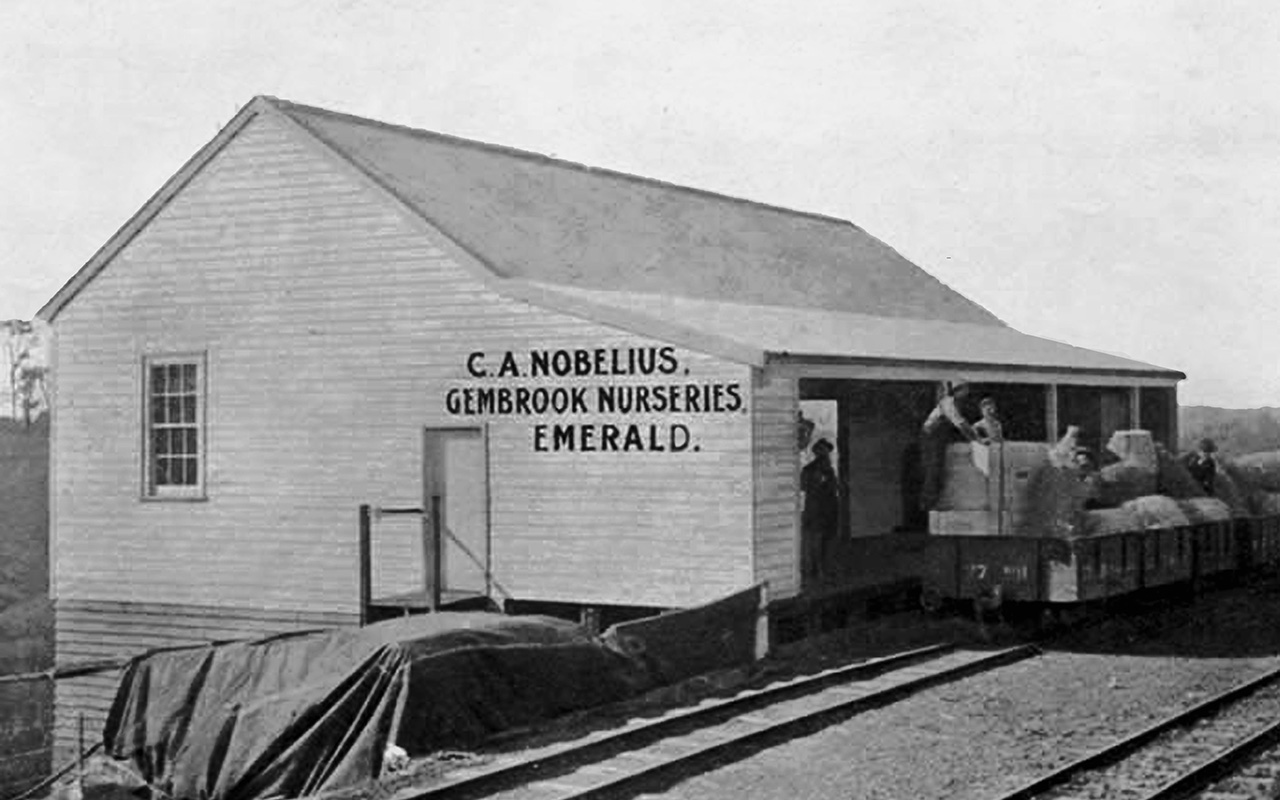
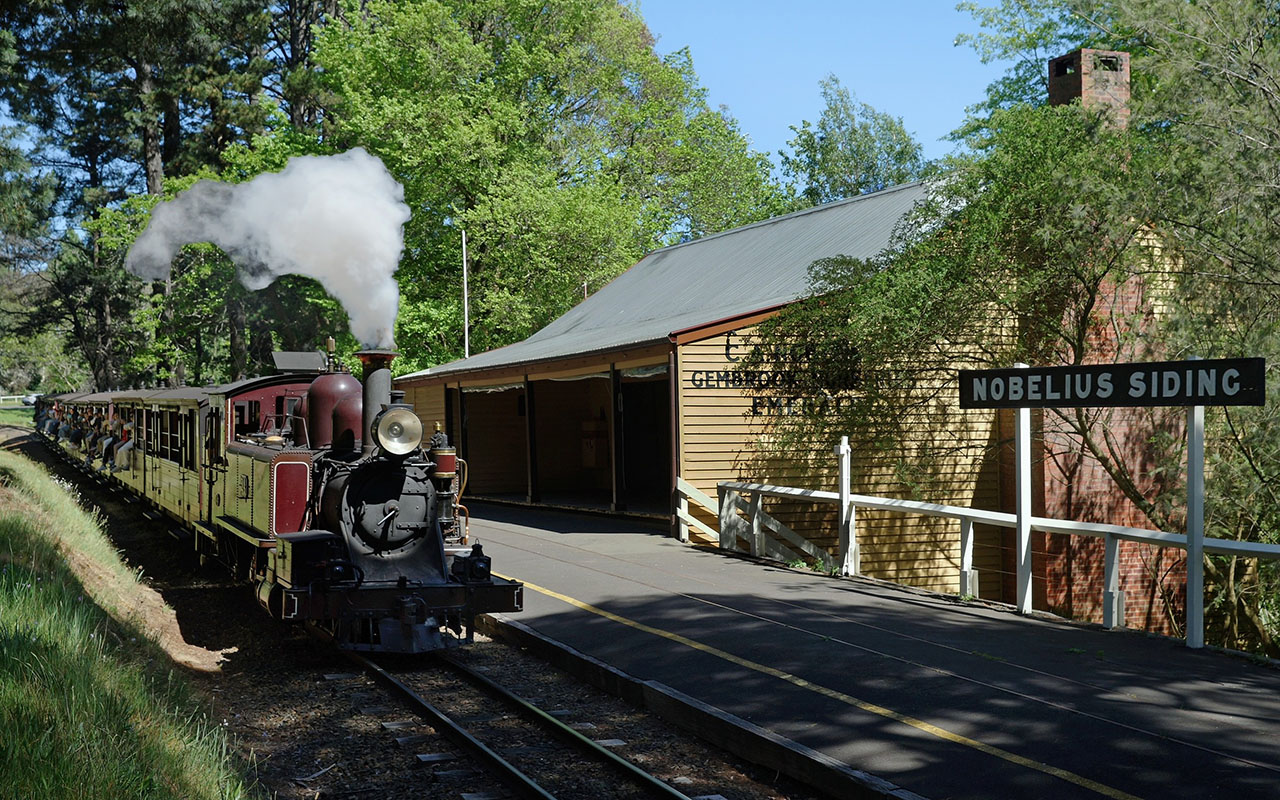
In early days moving fruit and plant stock was a slow and costly business. The nearest railhead for Gembrook was at Narre Warren and bullock drays had to cart the fruit or stock from the growers to the station. Nobelius was one of a group of growers who, in 1898, successfully sought to have the rail line extended from Ferntree Gully to Emerald. The line, later known as the Puffing Billy line, was opened in 1900. Carl Axel was given special permission to establish a siding and packing shed along the line to service the movement of plants and fruit to and from his nursery.
The difficulty in getting produce to markets was also a problem for the fruit growers around Red Hill and Merricks on the Mornington Peninsula. As in the Dandenong Hills, settlers had recognised the potential for orchards in the area and many turned to fruit growing. Apples, pears, stone fruits, berry fruits and cherries could find ready markets both in Melbourne and further afield if fruit reached markets quickly. After a rail line was put through to Stony Point in 1889 with the nearest railhead at Bittern, the growers had agitated for a branch line to Red Hill. Different routes were proposed but before any work could be done, the years of World War I intervened and the project was postponed. The line finally opened in 1921 and was well established by the time Ron Nobelius brought his family to Merricks.
Nobelius’ Nurseries and Kia Ora
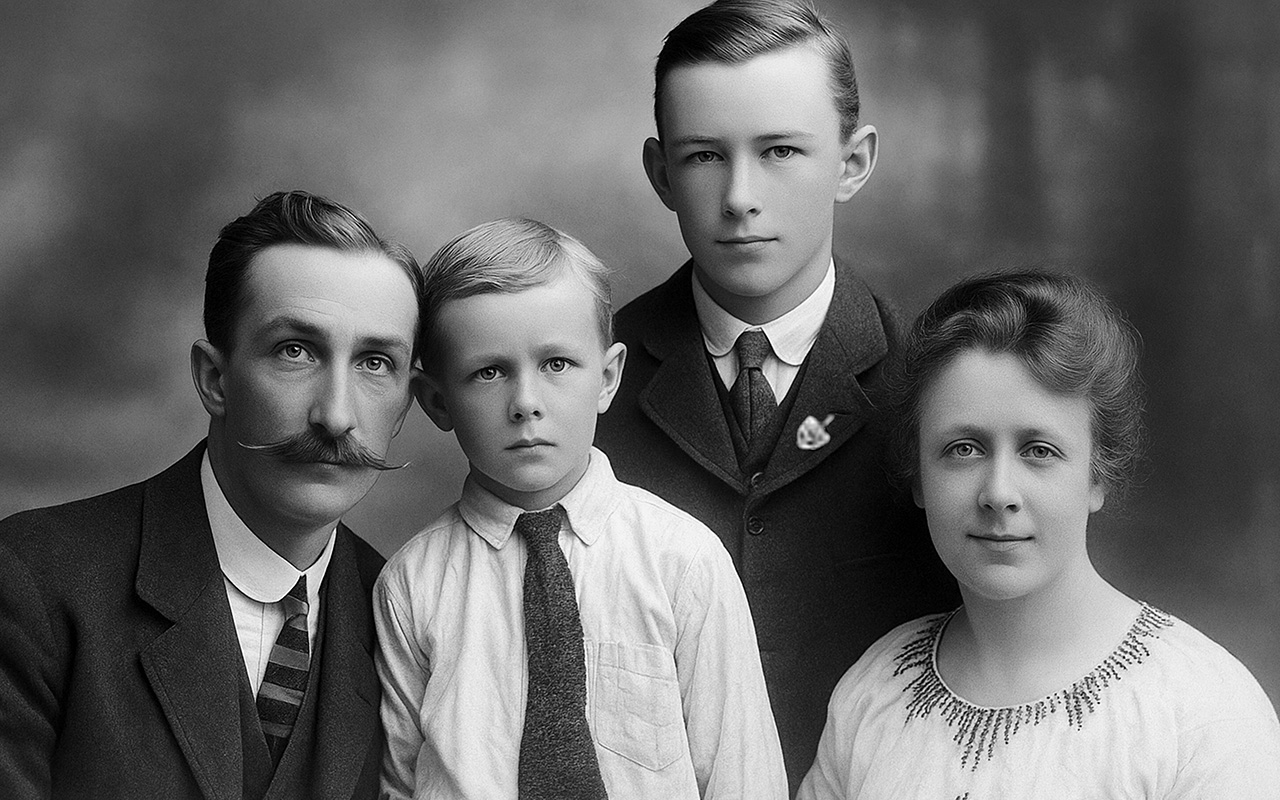
Nobby had grown up in Narre Warren. His father (Carl Oscar) was the eldest son of Carl Axel. When Carl Axel died in 1921 his will directed that the Emerald property be sold and the proceeds divided evenly between his five sons and three daughters. His sons acquired part of his estate and the remainder was sold to two syndicates. Approximately twelve acres continued operating as a wholesale nursery. Three of Carl Axel’s sons had a vested interest in the nursery which continued to run under the trading name of C. Nobelius & Sons. It was still very much a family business until it was sold in 1955. The name continued in use until 1967.
Oscar had worked in the family orchard but in 1910 he established his own orchard, ‘Kia Ora’ in the Narre Warren/Cranbourne North area. It produced apples and pears, berry fruits and passionfruit. He also planted out five acres with lavender and kept bees with the hives yielding honey. The lavender was also harvested for its oil to use in perfumery. A.V. Nobelius, Oscar’s brother ran the only lavender distillery in Victoria, at Emerald. Oscar had two sons who both became orchardists. Ron (Nobby) moved to the Mornington Peninsula. His younger brother Jack, an accomplished singer, bought land in Narre Warren South after serving in the army during World War II and established his own orchard where he grew apples and pears. Jack had previously worked with their father at ‘Kia Ora.’ The name Nobelius and orcharding were inseparable.
Cherry-picking
‘Cherrydale’ was renowned for the quality of its fruit and, at the time Peart sold it in 1947, was considered one of the best-known orchard properties in the state. Fruit picking was the busiest season – as at all orchards – and offered casual employment to those who wanted work. Many local people took advantage of the well-paying summer job. One teenage lass, Joan Sweeney, gives a picture of what working at ‘Cherrydale’ was like in the 1940s. “Excellent money could be earned cherry-picking. The rate was £1 (one pound) per day and £6 per week could be earned. (Sunday was the sabbath, not a day for work.) That was a small fortune in those days. The older ladies, the ‘mums’, made it quite a social occasion. They didn’t climb ladders and only picked about half the quantity of fruit that the young people picked. They earned about 10/- (ten shillings) a day (half the daily rate). They picked, ate cherries and had a good talk. You could eat as many cherries as you wanted but after the first couple of days you soon got sick of them.” For the Sweeneys, it was a family affair. Joan’s mother and two brothers joined her at the orchard. The annual ‘Cherrydale’ picnic was an event looked forward to by the pickers. At the end of the season Nobby organised a picnic, often at one of the nearby beaches, for those who had worked long hours picking the fruit.
Running ‘Cherrydale’ was a family affair for members of Nobby’s family too. His three daughters elected to work in the orchard and on the farm when they had completed their schooling. Daughter, Margaret, reminisced, “Dad had no sons so we (she, Jeanette and Jill) helped out. We helped with the spraying, pruning and picking of fruit as well as helping with the cattle. It was hard work at times but we enjoyed the outdoor work”.
Community Involvement
It wasn’t all work. The family was part of the community. The girls had attended the state school at Balnarring, walking or riding their bicycles the couple of miles from their home to the school. They knew the neighbours along the route and the neighbours knew them. Nobby served on the school’s committee. He was secretary of the Links of Service committee which helped keep active the school’s Junior Red Cross group and he joined the Dromana branch of the Masonic Lodge. Nobby’s wife, Amy, was a member of the local branch of the C.W.A.
One of the first groups that Nobby became involved with was the local fire brigade and he was an active member throughout his years at Merricks. The Balnarring brigade had been formed in 1921 but it wasn’t until 1937 that it was registered with the Bush Fire Authority. During the 1930s the brigade had no fire truck of its own. Nobby offered the members the use of his ute and trailer to carry equipment to fires. The equipment which consisted of four drums of water and beaters was stored in a shed at the orchard. This system continued for almost a decade as it wasn’t until 1947 that the brigade obtained a proper fire truck, an Austin. It was still housed at Cherrydale for a further three years until it was moved to a more central position and kept for three more years in a shed to the west of the general store. The members of the brigade then put together a Nissen hut as their first depot. During his years with the Fire Brigade, Nobby was captain from 1949 until 1951 and served as secretary from 1942 until 1951.
Ron Nobelius joined the Redhill Co-operative Cool Store Society. In 1948 the society succeeded in getting a cool store opened in Merricks North. This had a capacity to store 20, 000 cases and, along with the cool store in Red Hill, it increased the number of cases of fruit that could be stored in the district to 56,700. The new cool store was seen to be helping local producers and providing work for local packers. By 1949 Nobby was one of the Society’s directors.
A Heritage Park is Set Up and Cherrydale closes down
Both the Emerald Railway line and the Red Hill railway line closed in the early 1950s due to financial reasons. A landslide had also hastened the closure of the Puffing Billy line. Rail enthusiasts in the Dandenongs formed the Puffing Billy Preservation Society and gradually re-opened sections of the Belgrave to Gembrook line as a tourist attraction. The first tourist train ran in 1962. The Red Hill line was dismantled a few years after its closure.
The Nobelius family left ‘Cherrydale’ in 1951. When the orchard was sold the old packing shed with its name and mural of painted cherries on the doors remained a landmark for a number of years. The Merricks cool store building still stands along the Bittern-Dromana Road.
The building has been used for many purposes since its packing shed days. Orcharding on the Mornington Peninsula declined in the 1960s with many of the orchards being subdivided for houses or, in the 1970s, moving over to grape growing for vineyards. However, a few orchards still grow cherries around the Red Hill area.
In 1981 the nursery that had been established by the Nobelius family in Emerald finally closed its doors. A public campaign was launched for the land to be purchased as a community heritage landmark. The Shire of Sherbrooke, with assistance from the State government, bought the land and in 1993 the Nobelius Heritage Park was opened. It includes the Emerald museum which displays a number of artifacts once part of the original nursery. Puffing Billy makes a request stop at the Nobelius siding, today carrying tourists rather than produce.
The name Nobelius doesn’t have the same history on the Peninsula as it has around Gembrook. There are other families in the Merricks- Redhill area who are third or fourth generation fruit growers – families such as the Clarke family or the Huntleys. However, Nobby exercised the same experience and inherent family knowledge that stretched back generations. He was a Nobelius.
Puffing Billy and an orchard named ‘Cherrydale’ – an intriguing connection.
The Joseph Harris connection
There is another peninsula connection to the Nobelius family, albeit a slight one. Joseph Harris, the man for whom Carl Axel had worked, had a home, ’Marina’; in Mornington and also one at Mt Martha where he owned an 80-acre property. Harris was an experienced horticulturalist who often worked alongside Baron Von Mueller. He designed the gardens around the Royal Exhibition Buildings and was involved with founding the Burnley Horticultural Society. Harris also wrote a column on horticulture for The Argus newspaper. He experimented with seeds gathered from all over the world and some of the trees he planted at Mt Martha Park are still there. The Joseph Harris Boy Scouts Camp was built on land donated by Harris’ daughter. He died in 1925 and is buried in the Mornington Cemetery.
References: Australian Encyclopedia; Margaret (Nobelius) Ross: ‘Memoirs’; information from Emerald Museum & Nobelius Heritage Park; Balnarring & District Historical Society archives; contemporary newspapers via Trove
Photos: Nobelius family collection (BDHS); M. Adams; Rose postcard