
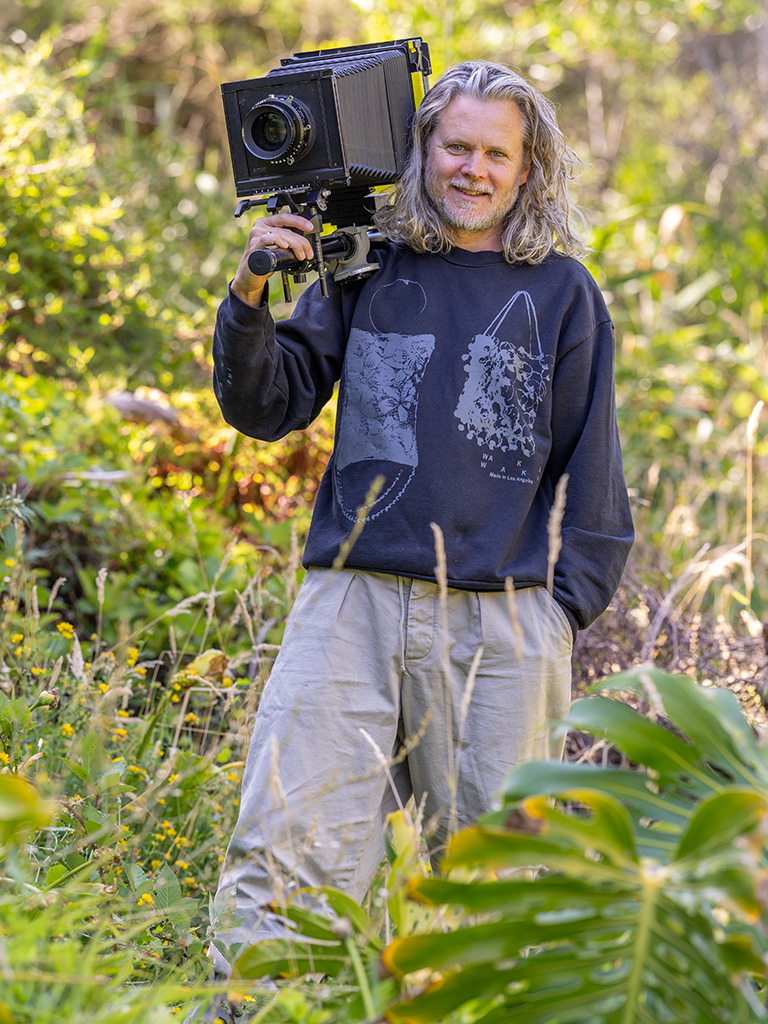
Frankston South photographer Casey Moore’s nomadic life has given him a keen eye for ‘place’. Born in Invercargill, New Zealand, his family moved to picturesque Villars, Switzerland on his third birthday. They moved back and forth to the idyllic English countryside before settling in London when Casey was 13 years old. He moved to Melbourne with his own family on his 47th birthday. Casey noticed that each place has its own unique fingerprint.
“There is a visual rhythm to every place. Having a camera gives me intention and an insightful way of seeing the world. It’s the intricate details that articulate a sense of place. I want to express that in my work,” he says. Seeing the beauty everywhere, Casey realised he could be happy anywhere, including cities, as long as he’s connected to nature. His mother, artist Victoria Moore, has captured the complexities of nature in pen and ink ever since Casey can remember. She took him to visit art galleries and stately homes regularly in his childhood. It formed his aesthetic sensibilities.
Meeting and then working with his wife, Claire, an artist, poet and former art therapist, has helped shape his artistic output over the past 20 years. “Having a partner who is there for the creative journey is just incredible. I don’t know where I’d be without someone to bounce ideas off and keep me going in tough times. She is committed to art and creativity as a way of processing and dealing with big world issues. I’m so inspired by that,” he says.
Casey comes with an impressive photographic pedigree. His great, great uncle, Arthur Iles, was a well-known New Zealand photographer of the late 19th and early 20th centuries renowned for capturing portraits of Maori people. His cousin, Henry Hargreaves is doing great photographic work in New York.
Always having an SLR camera on hand, Casey’s parents took lots of great photos in the many beautiful places they lived. Casey remembers using a camera for the first time when he was 15. He studied photography in high school and found the hands-on process of developing and printing photographs fascinating. Outside of those early studies, he is entirely self-taught.
His early exposure to natural landscapes made an indelible impression forming his future work. When he was 25, Casey was commissioned by the Austrian Tourist Board to take photos of classic Austrian landscapes.
“I was interested in conveying the overlap between humankind and nature. Our imprint is everywhere. Even in a landscape of the Austrian alps, I can see the impact of humans in things like power lines in the distance” he says.
Patterns in nature are a thread that run through much of Casey’s work. It’s something he started to notice as a very young boy, picking flowers in an alpine meadow with his mother.
Casey’s floral photographs are striking. “Each flower is totally unique. I want to show nature in its fully alive self,” he says.
I want to introduce something a little less bombastic and masculine to my work
Casey didn’t begin his working life in photography. He got a Master’s Degree in Psychology at Edinburgh University. The degree got him work in an advertising agency, but after two years the pull back to creativity became too strong and he left this work to pursue photography. He’s been working as a professional photographer ever since.
He uses a wide variety of cameras. His favourite all-rounder is his Pentax 67ii. It can produce exhibition – sized prints, but it’s still very portable. Film and digital formats appeal to him for different reasons, but he prefers film for recording the day to day.
“I think film does a better job of capturing the moment, especially if I’m photographing family for posterity. Every time I press the shutter, I’m creating a physical object on that piece of film. It’s indelible. It doesn’t need to be compressed onto a memory card and reassembled on a screen at a later date. It has more integrity than a digital file,” he says.
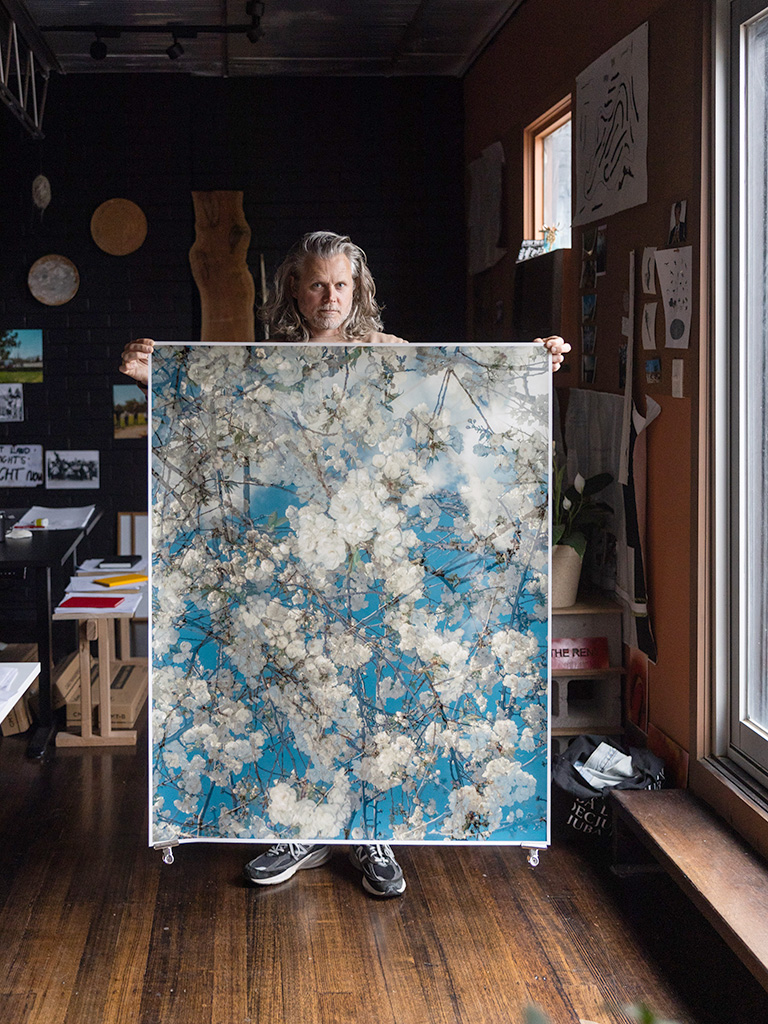
Casey makes enormous art prints using analogue techniques. He hand-processes them in his Melbourne studio to create truly original images. His goal is to connect his viewers to the nature he photographs. He wants to draw them in to his aesthetic so they appreciate the innate beauty of what he’s capturing.
His way of seeing the world is changing. “The way women photograph the world is really inspiring. I want to introduce something a little less bombastic and masculine to my work,” he says. Casey travels around the globe taking photos for large commercial clients, but he is always drawn back to nature. His fine art photography is about narratives in the natural world – patterns and connectivity – capturing the sublime.
Casey has exhibited his photographs in Australia and abroad. His work can be found in private collections in the UK, NZ, Australia, USA, Russia and Europe. Find his eye-catching images on his website or Instagram.